Motive Fluid (Primary)
psia
°F
lb/hr
Suction Fluid (Entrained)
psia
°F
lb/hr
Discharge & Design
psia
—
—
Calculated Design Parameters
Nozzle Sizing:
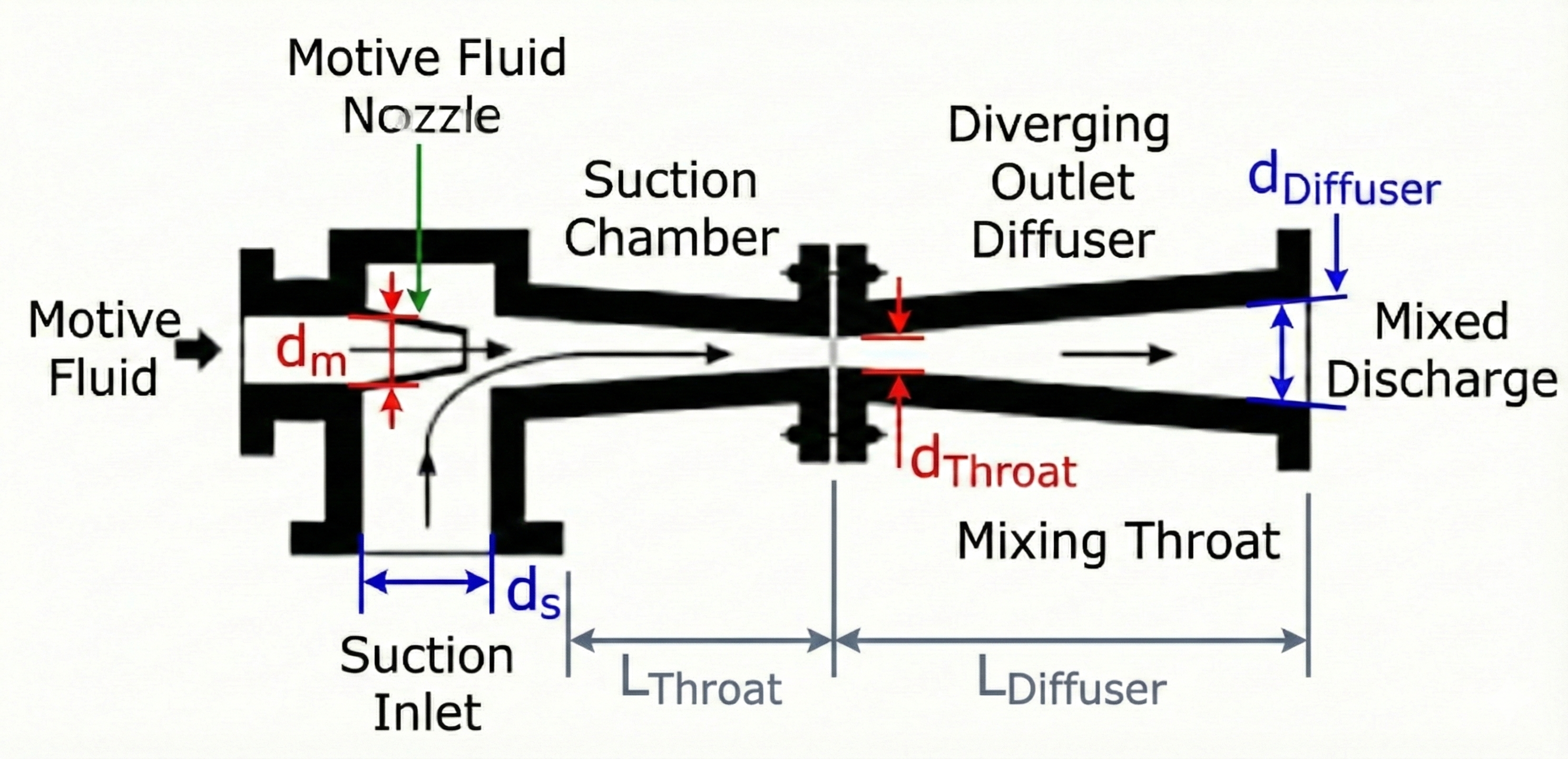
Motive Throat Diameter, Suction Inlet Area, Diffuser Throat, Nozzle Coefficient (Cd).
Motive Throat Diameter, Suction Inlet Area, Diffuser Throat, Nozzle Coefficient (Cd).
Performance Metrics:
Entrainment Ratio (ω), Compression Ratio, Steam Consumption, Efficiency.
Entrainment Ratio (ω), Compression Ratio, Steam Consumption, Efficiency.
Flow Analysis:
Critical Pressure Ratio, Isentropic Flow, Choked Flow Conditions, Mach Number.
Critical Pressure Ratio, Isentropic Flow, Choked Flow Conditions, Mach Number.
📚 Learn the Theory
Understand ejector design principles, calculations, and industry applications
About This Calculator
Designs steam jet ejectors per HEI Standards (5th Ed.) and ASME PTC 24 for vacuum systems, vapor recovery, and gas compression.
Methodology
- Nozzle sizing: Isentropic choked flow
- Steam flow: Napier equation
- Staging: HEI compression guidelines
- Efficiency: El-Dessouky correlations
Key Equations
Critical P ratio:
rc = (2/(k+1))k/(k-1)
rc = (2/(k+1))k/(k-1)
Mass flux:
G* = ρ* × a*
G* = ρ* × a*
Entrainment:
ω = ṁs / ṁm
ω = ṁs / ṁm
References
- HEI Standards for Steam Jet Vacuum Systems, 5th Ed.
- ASME PTC 24 — Ejectors
- El-Dessouky et al., Chem. Eng. Proc. (2002)
Quick Reference — Critical Pressure Ratios
| Fluid | γ (k) | P*/P₀ | Notes |
|---|---|---|---|
| Steam (superheated) | 1.327 | 0.545 | Use k=1.135 for wet steam |
| Air / N₂ / O₂ | 1.40 | 0.528 | Diatomic gases |
| Natural Gas / CH₄ | 1.31 | 0.544 | MW varies with composition |
| CO₂ | 1.30 | 0.546 | Triatomic |
HEI Staging Guidelines
CR < 4:1
Single stage
CR 4–10:1
Two stage + intercondenser
CR 10–40:1
Three stage
CR > 40:1
Four+ stages required
💡 Design Tip — Steam Quality
Per HEI standards, motive steam should have quality ≥98% and superheat <50°F for optimal performance. Excessive superheat reduces entrainment capacity; wet steam causes erosion and performance loss.