Calculation Mode
Design Requirements
Classical: truncated cone inlet. Nozzle: curved ISA 1932 profile
in
ISO 5167-4: 50mm to 1200mm (2" to 48")
MMSCFD
Base conditions flow at design point
in H₂O
Transmitter full-scale or design limit
ISO 5167-4 range: 0.30 - 0.75
Classical venturi standard is 21°
7-15° per ISO 5167-4. Lower = better pressure recovery
Operating Conditions
psig
psig
psig
Base conditions pressure for sizing
°F
psia
Gas Properties
-
Natural gas: 0.55-0.70
lb/lbmol
MW = SG × 28.97
-
Calculate from pressure & temperature
-
Natural gas: 1.27-1.31
Calculated Parameters
Design Outputs:
Throat Diameter, Beta Ratio (β), Convergent/Divergent Lengths, Total Length.
Throat Diameter, Beta Ratio (β), Convergent/Divergent Lengths, Total Length.
Flow Analysis:
Mass Flow Rate, Reynolds Number, Discharge Coefficient (C), Throat Velocity.
Mass Flow Rate, Reynolds Number, Discharge Coefficient (C), Throat Velocity.
Pressure Recovery:
Permanent Pressure Loss, Pressure Recovery Factor, Orifice Equivalent Loss Comparison.
Permanent Pressure Loss, Pressure Recovery Factor, Orifice Equivalent Loss Comparison.
📚 Learn the Theory
Understand venturi meter design, pressure recovery, and when to choose venturi vs orifice
Venturi Geometry
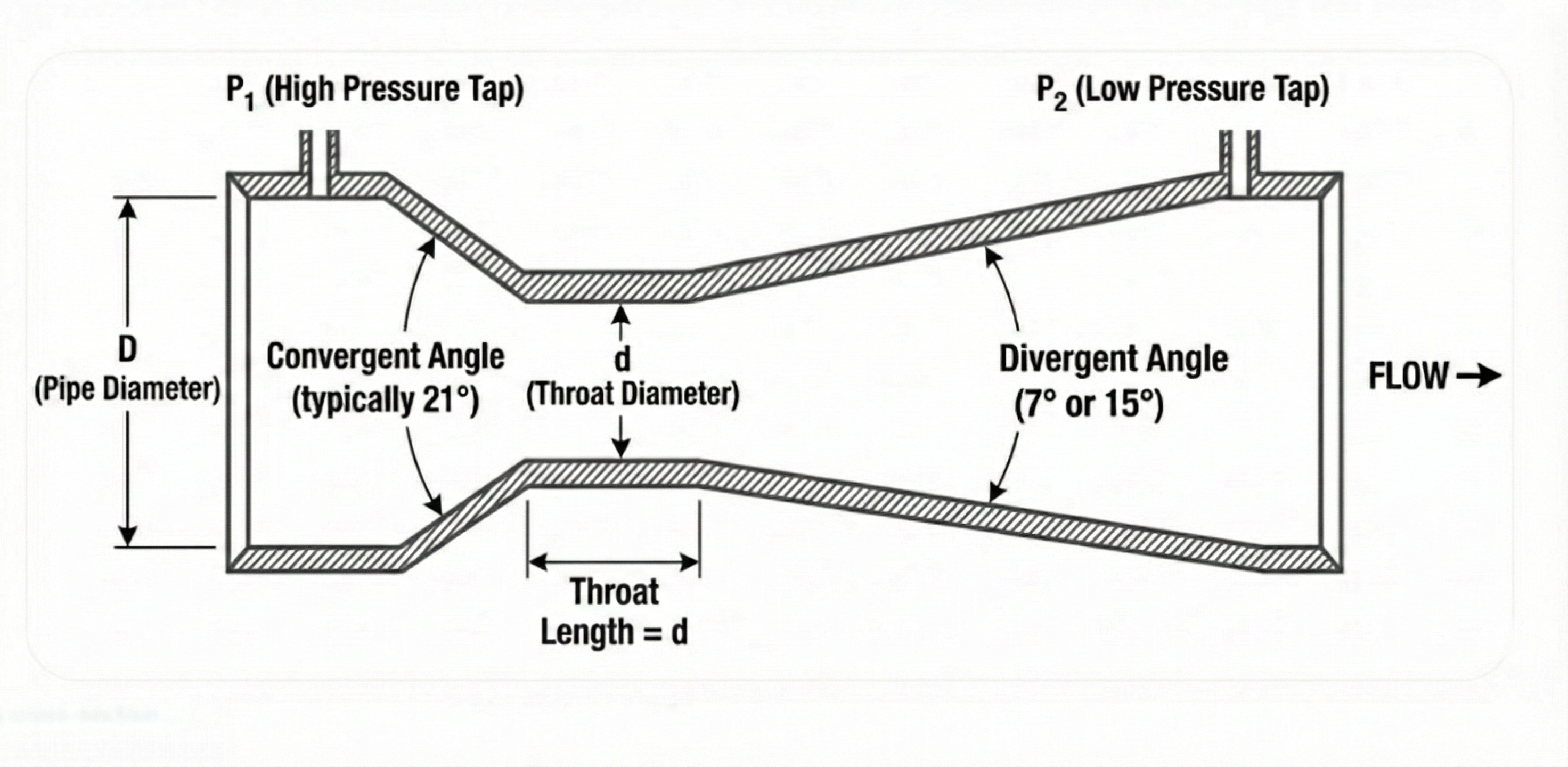
D = Pipe diameter | d = Throat diameter
β = d/D (0.30–0.75 per ISO 5167-4)
Throat length = d (one throat diameter)
β = d/D (0.30–0.75 per ISO 5167-4)
Throat length = d (one throat diameter)
Venturi Flow Equation
Q = C·ε·(π/4)·d²·√(2·ΔP/(ρ·(1-β⁴)))
C = Discharge coefficient (0.984-0.995)
ε = Expansibility factor
β = d/D (throat/pipe ratio)
ΔP = Differential pressure
Venturi vs Orifice
Permanent ΔP Loss:
10-30% vs 40-90%
Discharge Coeff:
0.984-0.995 vs 0.59-0.65
Straight Pipe:
Less required
Cost:
Higher initial
Standards & References
-
ISO 5167-4:2003
Venturi Tubes -
ASME MFC-3M
Measurement of Fluid Flow Using Orifice, Nozzle, and Venturi -
ASME Fluid Meters, 6th Ed.
Comprehensive Flow Measurement