API gravity is the petroleum industry's standard measure for expressing crude oil and product density. Developed by the American Petroleum Institute in 1921, it replaced inconsistent Baumé scales and provides an inverse density measure where lighter oils have higher API values.
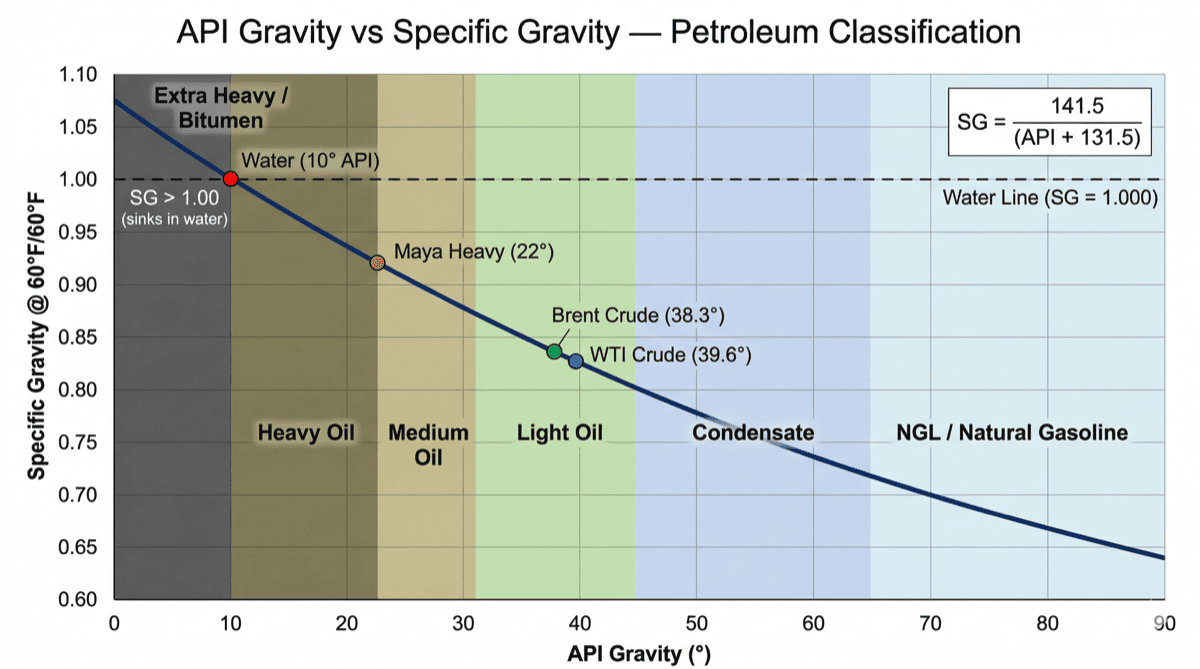
API gravity vs specific gravity relationship with petroleum classification zones. The curve follows SG = 141.5 / (°API + 131.5). Lighter oils have higher API gravity and lower specific gravity. Benchmark crudes shown: WTI (39.6°), Brent (38.3°), Maya Heavy (22°). Oils with API below 10° (SG > 1.0) sink in water.
API Gravity
Inverse Density Scale
Higher API = lighter oil. Scale designed so water = 10° API. Range: 10–70° for petroleum.
Specific Gravity
Density Ratio
Liquid density ÷ water density, both at 60°F. Dimensionless. Written as SG 60/60.
Why It Matters
Pricing & Yield
Light crudes yield more gasoline/diesel with less processing → $5–15/bbl premium over heavy.
Custody Transfer
Volume Correction
Temperature changes volume. Correct to 60°F using VCF tables for accurate invoicing.
The API Gravity Formula
API Gravity Definition (API MPMS 11.5.1):
°API = (141.5 / SG₆₀) − 131.5
Inverse:
SG₆₀ = 141.5 / (°API + 131.5)
Where:
• °API = API gravity in degrees
• SG₆₀ = Specific gravity at 60°F/60°F (dimensionless)
Key Reference Points:
• Water: SG = 1.000 → API = 10.0°
• Light crude (SG = 0.85): API = 35.0°
• Heavy crude (SG = 0.95): API = 17.4°
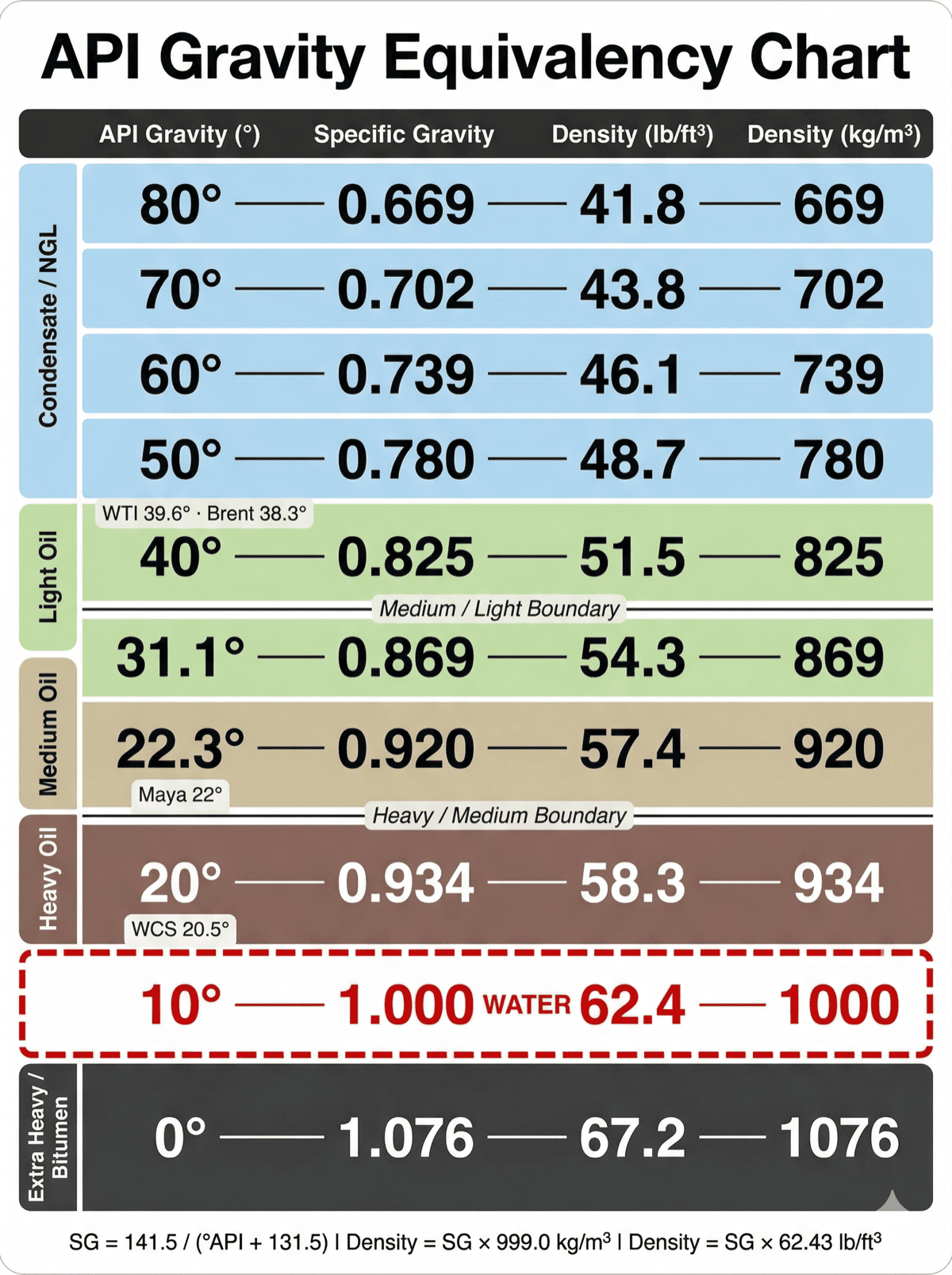
API gravity equivalency chart with four-unit conversion: API degrees, specific gravity, lb/ft³, and kg/m³. Color-coded zones from condensate/NGL (80° API) through light, medium, and heavy oil down to extra heavy bitumen (0° API). Water reference at 10° API, SG = 1.000, 62.4 lb/ft³.
Crude Oil Classification
Industry-standard thresholds per API, USGS, and EIA:
Classification
API Gravity
SG @ 60°F
Density (kg/m³)
Examples
Condensate
≥45°
≤0.80
≤801
NGL, lease condensate
Light
>31.1°
<0.87
<870
WTI (39.6°), Brent (38.3°), Arab Light (33.4°)
Medium
22.3–31.1°
0.87–0.92
870–920
Mars (28.9°), Dubai (31°)
Heavy
10–22.3°
0.92–1.00
920–1000
Maya (22°), WCS (20.5°)
Extra Heavy
<10°
>1.00
>1000
Orinoco (~9°), Bitumen (~8°)
Historical note: The constants 141.5 and 131.5 were chosen in 1921 to match hydrometers already in use (which had a modulus of 141.5 instead of the Baumé scale's 140) and to place water at exactly 10° API.
2. Conversion Formulas
API ↔ Specific Gravity
API to Specific Gravity:
SG₆₀ = 141.5 / (°API + 131.5)
Examples:
35° API → SG = 141.5 / 166.5 = 0.8498
22° API → SG = 141.5 / 153.5 = 0.9218
Specific Gravity to API:
°API = (141.5 / SG₆₀) − 131.5
Examples:
SG = 0.85 → API = 166.47 − 131.5 = 35.0°
SG = 0.92 → API = 153.80 − 131.5 = 22.3°
API/SG to Density
Density from Specific Gravity:
ρ (kg/m³) = SG₆₀ × 999.016 [ASTM D1250-08 water density]
ρ (lb/gal) = SG₆₀ × 8.3372
ρ (lb/ft³) = SG₆₀ × 62.37
Direct from API Gravity:
ρ (kg/m³) = 141,361 / (°API + 131.5)
ρ (lb/gal) = 1,179.71 / (°API + 131.5)
⚠️ Critical: API gravity does NOT blend linearly!
Correct method — blend by specific gravity, then convert:
1. Convert each crude to SG:
SG₁ = 141.5 / (API₁ + 131.5)
SG₂ = 141.5 / (API₂ + 131.5)
2. Volume-weighted average SG:
SG_blend = (V₁ × SG₁ + V₂ × SG₂) / (V₁ + V₂)
3. Convert back to API:
API_blend = (141.5 / SG_blend) − 131.5
Example: Blend 5,000 bbl of 28° API with 3,000 bbl of 38° API
SG₁ = 141.5 / 159.5 = 0.8872
SG₂ = 141.5 / 169.5 = 0.8348
SG_blend = (5000×0.8872 + 3000×0.8348) / 8000 = 0.8675
API_blend = 141.5 / 0.8675 − 131.5 = 31.6° API
(Linear averaging would incorrectly give 31.75°)
3. Volume Correction Factors (VCF)
Petroleum liquids expand when heated and contract when cooled. For fair custody transfer, measured volumes must be corrected to standard temperature (60°F) using Volume Correction Factors from API MPMS Chapter 11.1.
VCF Formula (API MPMS 11.1)
Volume Correction:
V₆₀ = V_obs × VCF
Where:
• V₆₀ = Standard volume at 60°F
• V_obs = Observed volume at measurement temperature
• VCF = Volume Correction Factor (also called CTL)
VCF Calculation:
VCF = exp[−α × ΔT × (1 + 0.8 × α × ΔT)]
Where:
• α = Thermal expansion coefficient = K₀ / ρ₆₀² (per °F)
• K₀ = 341.0957 (crude oil) or 330.301 (jet/kerosene); gasoline & fuel oils use K₀+K₁ forms
• ρ₆₀ = Density at 60°F in kg/m³ (= SG × 999.016)
• ΔT = T_obs − 60°F
Quick Rules:
• VCF < 1.0 when T > 60°F (liquid expanded → correct down)
• VCF > 1.0 when T < 60°F (liquid contracted → correct up)
• VCF = 1.0 when T = 60°F (no correction)
VCF Reference Table (Crude Oil)
°API
40°F
50°F
70°F
80°F
100°F
20 (heavy)
1.0078
1.0039
0.9961
0.9922
0.9843
30 (medium)
1.0089
1.0044
0.9955
0.9911
0.9821
40 (light)
1.0100
1.0050
0.9950
0.9899
0.9798
50 (condensate)
1.0112
1.0056
0.9944
0.9887
0.9774
Lighter crudes have larger VCF corrections (higher thermal expansion).
Thermal Expansion by API
°API
α (×10⁻⁴ /°F)
% Volume Change per 10°F
10
3.4
0.34%
20
3.9
0.39%
30
4.5
0.45%
40
5.0
0.50%
50
5.6
0.56%
Financial impact: For a 100,000 bbl cargo at 80°F of 35° API crude (VCF ≈ 0.9905), the standard volume is 99,050 bbl — a difference of 950 bbl worth ~$71,000 at $75/bbl. Accurate temperature measurement (±0.2°F) and proper VCF application are essential.
Other Correction Factors
Factor
Abbreviation
Purpose
Typical Magnitude
Temperature on Liquid
CTL
Same as VCF — thermal expansion
0.96–1.04
Pressure on Liquid
CPL
Compressibility under pressure
1.000–1.002 (usually negligible)
Combined
CTPL
CTL × CPL
Use for high-pressure metering
Temperature on Steel
CSW
Tank shell expansion
~0.01%/°F
4. Measurement Standards (ASTM)
ASTM D1298 — Hydrometer Method
Traditional laboratory method for API gravity measurement:
Procedure Summary:
1. Sample prep: Bring to ~60°F, remove water/solids, degas, pour into cylinder
2. Stabilize: Allow 30 min for temperature equilibrium; record T to ±0.1°F
3. Read: Lower hydrometer gently, let float freely, read at liquid surface (not meniscus top)
4. Correct: If T ≠ 60°F, apply VCF from API MPMS 11.1 tables
Precision:
• Repeatability: ±0.3° API
• Reproducibility: ±0.5° API
ASTM D4052 — Digital Density Meter
Modern oscillating U-tube method — preferred for lab and custody transfer QC:
Principle: Sample fills U-tube; resonant frequency depends on mass (density)
Sample size: 1–2 mL only
Speed: 2–5 minutes per test
Precision: ±0.0001 g/mL (±0.1° API)
Temperature: Peltier-controlled to ±0.01°C
Calibration: Two-point using air and distilled water
Method Comparison
Method
Accuracy
Speed
Best For
Hydrometer (D1298)
±0.5° API
30–45 min
Field, low cost
Digital meter (D4052)
±0.1° API
2–5 min
Lab, custody transfer
Coriolis (inline)
±0.2° API
Continuous
Pipeline metering
Common Measurement Errors
Error Source
Impact
Prevention
Temperature error ±1°F
±0.05–0.08° API
Use calibrated thermometer
Reading meniscus top
+0.3° API
Read at liquid surface
Hydrometer touching wall
Biased reading
Center hydrometer, let float free
Entrained gas/water
Incorrect density
Degas sample, drain water
Wrong VCF table
0.1–0.3° API
Use Table 5A for crude, 6A for products
Custody transfer requirements: Both buyer and seller representatives witness sampling (per API MPMS Ch. 8). Retain split samples for referee testing. Document: observed API, temperature, VCF applied, and final API at 60°F. Measurement uncertainty directly affects revenue.
5. Practical Applications
Crude Oil Pricing
API gravity directly affects crude value through refinery yield differences:
Typical Price Differentials:
Light crude (40° API) commands premium because:
• Higher gasoline/diesel yield (45–50% vs 25–30% for heavy)
• Lower processing costs (less cracking/coking needed)
Approximate differentials vs. WTI benchmark:
• Light sweet (>35° API, <0.5% S): Benchmark price
• Medium sour (25–35° API): −$3 to −8/bbl
• Heavy sour (<25° API): −$8 to −15/bbl
• Extra heavy (<15° API): −$15 to −25/bbl
Note: Actual spreads vary with refinery config, product demand, and logistics.
Problem: Final API after mixing tank inventories
Given:
• Tank 1: 5,000 bbl of 28° API
• Tank 2: 3,000 bbl of 38° API
Solution:
Step 1 — Convert to SG:
SG₁ = 141.5 / 159.5 = 0.8872
SG₂ = 141.5 / 169.5 = 0.8348
Step 2 — Blend SG:
SG_blend = (5000 × 0.8872 + 3000 × 0.8348) / 8000 = 0.8675
Step 3 — Convert to API:
API_blend = 141.5 / 0.8675 − 131.5 = 31.6° API
✓ Result is between 28° and 38°, weighted toward the larger volume.
Summary: API gravity is fundamental to crude valuation, transportation, and refining. Always: (1) measure temperature accurately (±0.2°F), (2) apply correct VCF for crude vs. products, (3) blend using SG not API, and (4) document all custody transfer measurements per API MPMS standards.
How do you convert API gravity to specific gravity?+
Specific gravity at 60°F is calculated as SG = 141.5 / (°API + 131.5). For example, 35° API crude has SG = 141.5 / 166.5 = 0.8498. The formula is defined in API MPMS 11.5.1.
What is the API gravity of water?+
Water has an API gravity of 10° (SG = 1.000 at 60°F). Petroleum liquids with API gravity greater than 10° float on water. Most crude oils range from 20° to 45° API.
Why can't you average API gravities when blending crude oils?+
API gravity does not blend linearly because it is an inverse density scale. The correct method is to convert each crude to specific gravity, calculate a volume-weighted average SG, then convert back to API gravity.
What is a Volume Correction Factor (VCF) and when is it used?+
VCF corrects measured petroleum volumes to standard temperature (60°F) for fair custody transfer. VCF is less than 1.0 when temperature exceeds 60°F (liquid expanded) and greater than 1.0 below 60°F (liquid contracted). Lighter crudes require larger VCF corrections due to higher thermal expansion.