Tank Configuration
⚙️ Head Selection Guide
Hemispherical: Highest pressure rating, V = ⅔πr³
2:1 Elliptical: Most common ASME, V = 0.1309D³
Torispherical: Economical, lower pressure
2:1 Elliptical: Most common ASME, V = 0.1309D³
Torispherical: Economical, lower pressure
Fill Level
ft
Leave at 0 for full tank capacity
📏 Measurement Reference
For horizontal cylinders, measure from tank bottom to liquid surface. Per API MPMS 3.1A, use calibrated gauge tape from reference point.
Advanced Options
Temperature correction, wall thickness, strapping table
⚡ Quick Conversion Reference
1 barrel (bbl)
= 42 US gallons
1 ft³
= 7.48052 gallons
1 ft³
= 0.178108 barrels
1 m³
= 6.28981 barrels
Supported Units & Outputs
Input Units:
Feet (ft), Inches (in), Meters (m), Centimeters (cm), Millimeters (mm).
Feet (ft), Inches (in), Meters (m), Centimeters (cm), Millimeters (mm).
Volume Outputs:
US Gallons, Barrels (bbl), Liters, Cubic Meters (m³), Cubic Feet (ft³).
US Gallons, Barrels (bbl), Liters, Cubic Meters (m³), Cubic Feet (ft³).
Calculations:
Total Capacity, Partial Fill Volume, Surface Area, 60°F Corrected Volume (Net), Strapping Tables.
Total Capacity, Partial Fill Volume, Surface Area, 60°F Corrected Volume (Net), Strapping Tables.
📚 Learn the Theory
Geometric volume formulas, horizontal tank segments, and unit conversions
Tank Geometry Reference
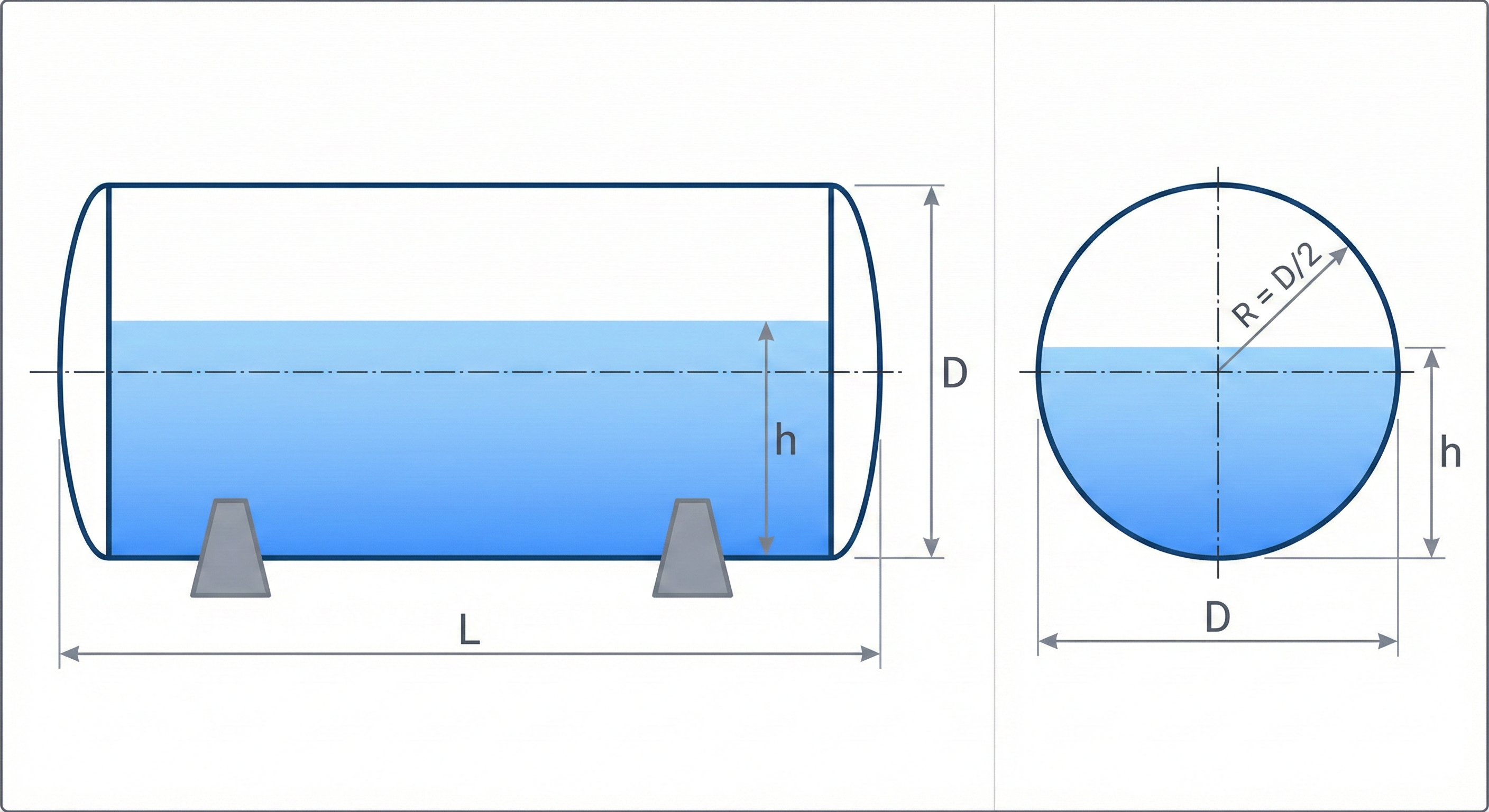
V = L × r² × [θ - sin(θ)] / 2
Volume Formulas
VERTICAL CYLINDER
V = π × r² × h
HORIZONTAL CYLINDER (Partial Fill)
V = L × r² × [θ - sin(θ)] / 2
θ = 2·arccos[(r-h)/r]
h = liquid height
SPHERICAL CAP
V = πh²(3R - h) / 3
2:1 ELLIPTICAL HEAD
V = 0.1309 × D³
D = inside diameter
Depth = D/4
Standards & References
-
API MPMS Ch. 2
Tank Calibration (supersedes 2550) -
API MPMS Ch. 11.1
Volume Correction Factors -
API 650
Welded Tanks for Oil Storage -
API 12F
Shop Welded Tanks -
ASME Section VIII
Pressure Vessel Heads
Important Notes
- Calculations assume ideal geometric shapes. Actual capacities vary due to manufacturing tolerances.
- Partial fill calculations assume tank is level. For out-of-level tanks, apply wedge corrections per API MPMS 3.1A.
- Always verify with tank strapping tables or certified drawings for custody transfer.
- Temperature correction is required for custody transfer per API MPMS Chapter 12.
⚠️ Disclaimer
For preliminary design only. Verify all calculations with a licensed engineer before use in custody transfer or regulatory compliance.