Natural Gas Unit Conversions: Engineering Reference Guide
Convert between gas volume units (scf, mcf, mmscf, bcf, m³), understand standard conditions definitions, calculate mass-volume relationships, and work with international unit systems.
Understand different standard condition definitions.
Calculate mass from volumetric flow rates.
1. Overview & Applications
Gas volume measurements vary significantly with pressure and temperature, making standardized reference conditions essential for accurate reporting, contracts, and custody transfer. Unlike liquids, gases are highly compressible, requiring careful attention to basis and units.
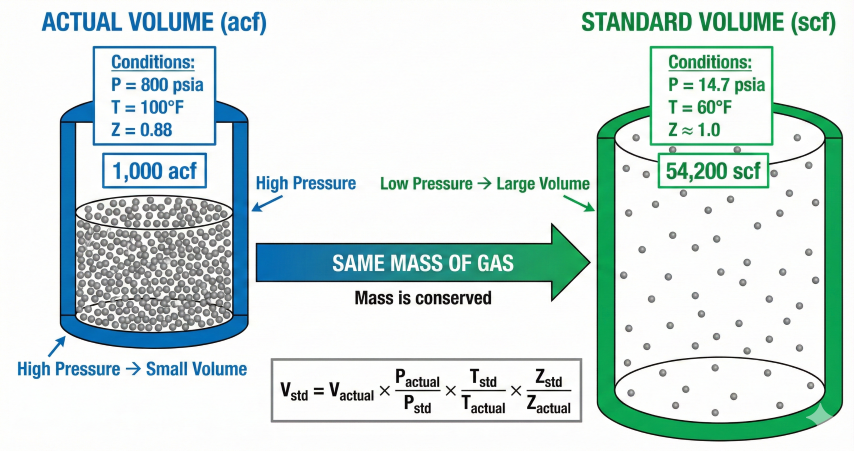
Same mass of gas occupies different volumes at actual flowing conditions versus standard reference conditions. High pressure compresses gas; correction to standard conditions expands volume ~54×.
Custody transfer
Contract volumes
Sales contracts specify standard conditions; errors cause revenue disputes.
Regulatory reporting
Emissions & production
EPA and state agencies require specific units and standard conditions.
Engineering design
Equipment sizing
Compressors, meters, and pipelines sized using standard volume flow rates.
International projects
Unit system translation
Converting between US customary and SI/metric systems for global operations.
Key Concepts
Standard volume: Gas volume corrected to specified standard P and T (e.g., scf, Nm³)
Actual volume: Gas volume at actual flowing conditions (acf, am³)
Standard conditions: Reference pressure and temperature for volume normalization
Heating value basis: Energy content per unit volume depends on standard conditions used
Why conversions matter: A 1 Bcf/d gas sales contract using different standard conditions between buyer and seller can result in 2-3% volume discrepancy, translating to millions of dollars annually. Explicit definition of basis is critical.
2. Volume Unit Systems
Gas volumes are reported in numerous units depending on industry, region, and application. Understanding the hierarchy and conversion factors is essential for engineering calculations.
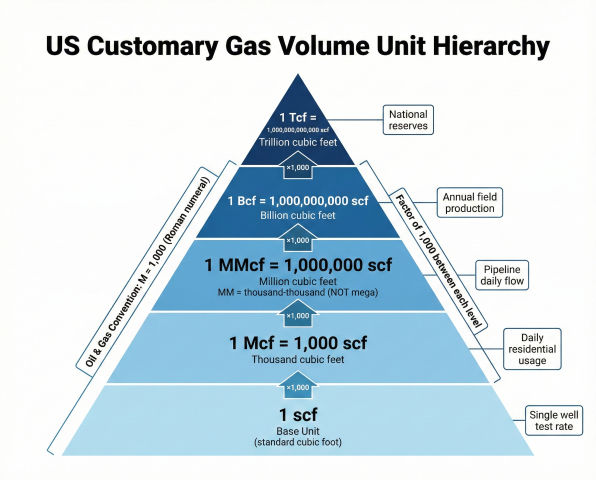
US customary gas volume unit hierarchy: Each level represents ×1,000. Note "MM" means thousand-thousand (1 million), not SI mega.
US Customary Volume Units
Standard Cubic Feet (scf) Hierarchy:
1 scf = 1 standard cubic foot (base unit)
1 Mcf = 1,000 scf (thousand cubic feet)
1 MMcf = 1,000,000 scf (million cubic feet)
1 Bcf = 1,000,000,000 scf (billion cubic feet)
1 Tcf = 1,000,000,000,000 scf (trillion cubic feet)
Note on "M" notation:
In oil & gas, "M" traditionally means 1,000 (Roman numeral)
"MM" means thousand-thousand = 1,000,000
This differs from SI where "M" = mega = 1,000,000
Common confusion:
- MMscfd = million standard cubic feet per day (NOT mega-mega)
- Mscfd = thousand standard cubic feet per day
SI/Metric Volume Units
Standard Cubic Meters (Sm³) Hierarchy:
1 Sm³ = 1 standard cubic meter (base unit)
1 kSm³ = 1,000 Sm³ (thousand Sm³)
1 MSm³ = 1,000,000 Sm³ (million Sm³) - often written as 10⁶ Sm³
1 GSm³ = 1,000,000,000 Sm³ (billion Sm³) - often written as 10⁹ Sm³
Alternative notation:
Nm³ = Normal cubic meter (often used in Europe)
Sm³ = Standard cubic meter (ISO convention)
Technically different standard conditions but often used interchangeably:
- Nm³: 0°C, 101.325 kPa (European "normal" conditions)
- Sm³: 15°C, 101.325 kPa (ISO 13443 standard conditions)
Conversion Between US and SI Units
Fundamental Conversion (same standard conditions):
1 m³ = 35.3147 ft³
Therefore, at identical standard conditions:
1 Sm³ = 35.3147 scf
1 scf = 0.0283168 Sm³
Common flow rate conversions:
1 Sm³/d = 35.3147 scfd
1 MMscfd = 28,316.8 Sm³/d
1 MSm³/d = 35.3147 MMscfd
Large volume conversions:
1 Bcf = 28.317 million Sm³ = 28.317 MSm³
1 Tcf = 28,317 billion Sm³ = 28,317 GSm³
Quick Reference Conversion Table
From
To
Multiply by
Example
scf
Sm³
0.0283168
1000 scf = 28.32 Sm³
Sm³
scf
35.3147
100 Sm³ = 3531 scf
MMscfd
Sm³/d
28,316.8
10 MMscfd = 283,168 Sm³/d
MSm³/d
MMscfd
35.3147
5 MSm³/d = 176.6 MMscfd
Bcf
MSm³
28.3168
1 Bcf = 28.32 MSm³
Tcf
GSm³
28.3168
1 Tcf = 28.32 GSm³
Actual vs Standard Volume
Actual Cubic Feet (acf) vs Standard (scf):
acf = volume at actual flowing pressure and temperature
scf = volume corrected to standard conditions (14.7 psia, 60°F)
Relationship via ideal gas law:
Q_std = Q_actual × (P_actual/P_std) × (T_std/T_actual) × (Z_std/Z_actual)
Example:
10,000 acfm at 500 psia, 80°F (Z = 0.90)
Standard conditions: 14.7 psia, 60°F (Z ≈ 1.0)
Q_std = 10,000 × (500/14.7) × (520/540) × (1.0/0.90)
Q_std = 10,000 × 34.01 × 0.963 × 1.111
Q_std = 363,700 scfm
Note: Actual volume is much smaller than standard volume at high pressure.
Energy Content Conversions
Gas volume is often converted to energy units for fuel applications:
Heating Value Conversions:
For typical pipeline natural gas (1,020 Btu/scf HHV):
1 MMscf = 1,020 MMBtu (HHV)
1 Bcf = 1.02 trillion Btu = 1.02 TBtu
SI energy units:
1 Sm³ = 38.3 MJ (for gas with 38.3 MJ/Sm³ HHV)
1 MSm³ = 38.3 TJ (terajoules)
Cross-unit energy conversion:
1 MMBtu = 1.055 GJ (gigajoules)
1 scf × 1,020 Btu/scf = 1,020 Btu = 1.076 MJ
Note: Heating value varies with gas composition (950-1,100 Btu/scf typical range).
Always verify HHV for accurate energy conversions.
This is a quick reference. For the full volume-to-energy conversion — including the MCF→MMBTU formula, GPA 2145 component heating values, composition effects, and worked gas-sales examples — see the dedicated MCF to MMBTU conversion guide.
3. Standard Conditions
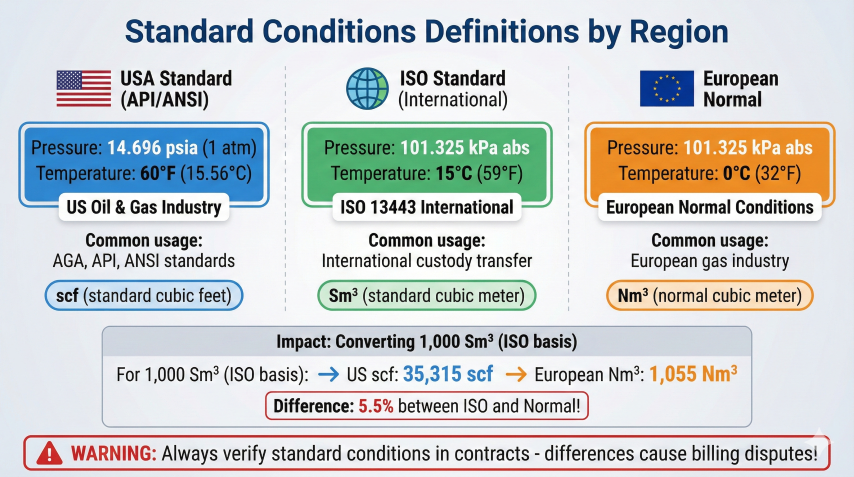
Multiple definitions of "standard conditions" exist globally, each producing different volumetric measurements for the same mass of gas. Contracts and regulations must explicitly state which standard applies.
Standard conditions vary by region: US uses 60°F, ISO uses 15°C, European Normal uses 0°C. The 5.5% difference between ISO and Normal can cause significant billing disputes.
Common Standard Condition Definitions
Standard Name
Pressure
Temperature
Usage
US/API (60°F)
14.696 psia (1 atm)
60°F (15.56°C)
US oil & gas industry standard, AGA/API/ANSI
US/EPA
14.7 psia
68°F (20°C)
EPA emissions reporting (40 CFR Part 98)
ISO 13443
101.325 kPa abs
15°C (59°F)
International standard, custody transfer
European "Normal"
101.325 kPa abs
0°C (32°F)
Europe, denoted as Nm³ (Normal cubic meter)
SPE (petroleum)
14.65 psia
60°F (15.56°C)
Some petroleum engineering texts
STP (scientific)
100 kPa (14.5 psia)
0°C (273.15 K)
IUPAC scientific standard (not industry)
Impact of Different Standards
The same mass of gas occupies different "standard volumes" under different standard conditions:
Volume Correction Between Standards:
V₂ = V₁ × (P₁/P₂) × (T₂/T₁)
Example: Convert 1.000 MMscf at US standard to ISO standard
US standard: 14.696 psia, 60°F (519.67°R)
ISO standard: 14.696 psia, 15°C (59°F = 518.67°R)
Since pressures identical, only temperature differs:
V_ISO = 1.000 MMscf × (518.67 / 519.67)
V_ISO = 0.9981 MMscf
Difference: 0.19% (1,900 scf per MMscf)
Example: Convert 1.000 Sm³ (ISO) to Nm³ (European normal)
ISO: 101.325 kPa, 15°C (288.15 K)
Normal: 101.325 kPa, 0°C (273.15 K)
V_Nm3 = 1.000 × (288.15 / 273.15)
V_Nm3 = 1.0549 Nm³
Difference: 5.49% - significant for custody transfer!
Contract Language Best Practices
Explicit standard conditions must be stated in gas sale agreements:
Example Contract Clause:
"All gas volumes shall be measured and reported in standard cubic feet (scf)
referenced to a base pressure of 14.73 psia and a base temperature of 60°F.
Volumes shall be calculated in accordance with AGA Report No. 3 (orifice
metering) and AGA Report No. 8 (compressibility). Heating value shall be
reported as higher heating value (HHV) on a dry basis at the same standard
conditions."
Critical elements to specify:
- Volume units (scf, Sm³, etc.)
- Standard pressure (psia or kPa abs)
- Standard temperature (°F or °C)
- Dry or saturated basis
- Compressibility method (ideal gas, AGA-8, etc.)
- Heating value basis (HHV or LHV, wet or dry)
Gross vs Net Heating Value
Standard conditions also affect heating value reporting:
Higher (Gross) Heating Value (HHV): Includes heat from water vapor condensation; used in US (Btu/scf)
Lower (Net) Heating Value (LHV): Excludes condensation heat; used in Europe (MJ/Sm³)
Critical for fuel contracts: 1 Bcf at 1,020 Btu/scf HHV ≠ 1 Bcf at 1,020 Btu/scf LHV!
Hidden contract risk: A gas sales contract for "10 MMscfd" without specifying standard conditions can have 2-6% volume ambiguity depending on buyer and seller assumptions. This translates to 200,000-600,000 scf/d disagreement, worth $600-1,800/day at $3/Mscf gas price.
4. Mass-Volume Relationships
Converting between mass flow (lb/hr, kg/s) and volumetric flow (scfd, Sm³/d) requires knowledge of gas composition and standard conditions. This is essential for material balances, emissions calculations, and equipment sizing.
Ideal Gas Density at Standard Conditions
Gas Density (Ideal Gas Law):
ρ_std = (P_std × MW) / (R × T_std)
Where:
ρ_std = Gas density at standard conditions (lb/ft³ or kg/m³)
P_std = Standard pressure (psia or Pa abs)
MW = Molecular weight (lb/lbmol or g/mol)
R = Universal gas constant
= 10.73 psia·ft³/(lbmol·°R) [US units]
= 8.314 J/(mol·K) [SI units]
T_std = Standard temperature (°R or K)
For US standard conditions (14.696 psia, 60°F = 519.67°R):
ρ_std = (14.696 × MW) / (10.73 × 519.67)
ρ_std = 0.002638 × MW (lb/ft³)
For natural gas with MW = 18.0:
ρ_std = 0.002638 × 18.0 = 0.0475 lb/ft³
For ISO standard conditions (101.325 kPa, 15°C = 288.15 K):
ρ_std = (101,325 × MW) / (8,314 × 288.15)
ρ_std = 0.04230 × MW (kg/m³)
For same natural gas (MW = 18.0 g/mol):
ρ_std = 0.04230 × 18.0 = 0.761 kg/m³
Mass to Volume Conversion
Converting Mass Flow to Standard Volume Flow:
Q_std = ṁ / ρ_std
Or using molecular weight directly:
Q_scf = (ṁ_lb/hr × R × T_std) / (P_std × MW)
Q_scf = (ṁ_lb/hr × 10.73 × 519.67) / (14.696 × MW)
Q_scf = 379.5 × (ṁ_lb/hr / MW) [scf/hr]
Simplification for quick calculations:
1 lbmol of ideal gas at 14.7 psia, 60°F occupies 379.5 scf
Therefore:
Q_scfd = (ṁ_lb/day / MW) × 379.5
Example:
5,000 lb/day of methane (MW = 16.04)
Q = (5,000 / 16.04) × 379.5 = 118,300 scfd
Verify: ρ_std = 0.002638 × 16.04 = 0.0423 lb/ft³
Q = 5,000 lb/day / 0.0423 lb/ft³ = 118,200 scfd ✓
Specific Gravity Method
For natural gas, specific gravity (SG) relative to air is often known instead of molecular weight:
Mass to Volume (SI/Metric):
For ISO standard conditions (101.325 kPa, 15°C = 288.15 K):
1 kmol of ideal gas occupies 23.645 Sm³
Q_Sm³ = (ṁ_kg / (MW_g/mol)) × 23.645 [Sm³/unit time]
Or using density:
ρ_std = 0.04230 × MW (kg/m³)
Q_Sm³/d = ṁ_kg/day / ρ_std
Example:
1,000 kg/day of natural gas (MW = 18.0 g/mol)
ρ_std = 0.04230 × 18.0 = 0.761 kg/m³
Q = 1,000 / 0.761 = 1,314 Sm³/day
Or: Q = (1,000 / 18.0) × 23.645 = 1,314 Sm³/day ✓
Quick Reference: Mass-Volume Factors
Gas Component
MW
lb/Mscf (US std)
kg/kSm³ (ISO std)
Methane (C₁)
16.04
42.3
678
Ethane (C₂)
30.07
79.3
1,271
Propane (C₃)
44.10
116.3
1,865
n-Butane (C₄)
58.12
153.3
2,457
Natural gas (typical)
18.0
47.5
761
Air
28.97
76.4
1,225
CO₂
44.01
116.1
1,861
H₂S
34.08
89.9
1,441
Composition-Based Calculations
For gas mixtures, molecular weight is calculated from mole fractions:
Mixture Molecular Weight:
MW_mix = Σ(y_i × MW_i)
Where:
y_i = Mole fraction of component i
MW_i = Molecular weight of component i
Example gas composition:
Component Mole % MW y_i × MW_i
Methane 85.0% 16.04 13.63
Ethane 8.0% 30.07 2.41
Propane 3.5% 44.10 1.54
n-Butane 1.0% 58.12 0.58
Nitrogen 2.0% 28.01 0.56
CO₂ 0.5% 44.01 0.22
-------
MW_mix = 18.94
SG = 18.94 / 28.97 = 0.654
Density at US std conditions:
ρ_std = 0.002638 × 18.94 = 0.0500 lb/ft³
For 10,000 lb/day:
Q = 10,000 / 0.0500 = 200,000 scfd
5. Temperature & Pressure Corrections
Converting between actual flowing conditions and standard conditions requires accurate pressure and temperature corrections, accounting for real gas behavior through the compressibility factor Z.
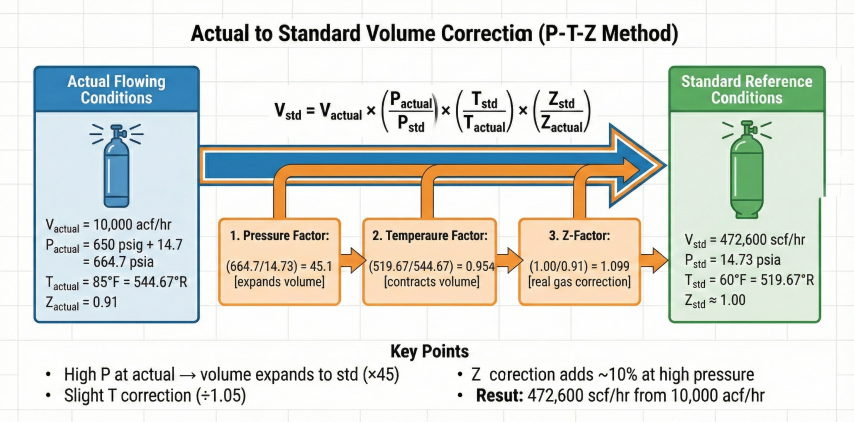
Actual to Standard Volume Correction: Pressure factor dominates (×45), with smaller temperature and Z-factor adjustments. Result: 10,000 acf/hr → 472,600 scf/hr.
Ideal Gas Correction
Volume Correction (Ideal Gas):
V_std = V_actual × (P_actual / P_std) × (T_std / T_actual)
Where:
V_std = Volume at standard conditions
V_actual = Volume at actual conditions
P = Absolute pressure (must use psia or Pa abs, not gauge)
T = Absolute temperature (°R or K)
Example:
Meter reads 5,000 acf/hr at 800 psig, 95°F
Standard conditions: 14.7 psia, 60°F
P_actual = 800 + 14.7 = 814.7 psia
T_actual = 95 + 459.67 = 554.67 °R
T_std = 60 + 459.67 = 519.67 °R
V_std = 5,000 × (814.7 / 14.7) × (519.67 / 554.67)
V_std = 5,000 × 55.42 × 0.9369
V_std = 259,500 scf/hr
Note: High-pressure gas expands greatly when brought to atmospheric pressure.
Real Gas Correction (Compressibility Factor)
Volume Correction Including Z-factor:
V_std = V_actual × (P_actual / P_std) × (T_std / T_actual) × (Z_std / Z_actual)
For most applications:
Z_std ≈ 1.00 (at 14.7 psia, gas behaves nearly ideally)
Therefore:
V_std = V_actual × (P_actual / P_std) × (T_std / T_actual) × (1.00 / Z_actual)
Example with Z-factor:
Same conditions as above, but Z_actual = 0.88 (high pressure)
V_std = 5,000 × (814.7 / 14.7) × (519.67 / 554.67) × (1.00 / 0.88)
V_std = 5,000 × 55.42 × 0.9369 × 1.136
V_std = 294,800 scf/hr
Ignoring Z-factor underestimates standard volume by 13.6% at these conditions.
Calculating Z-Factor
For accurate corrections, Z must be calculated based on gas composition, pressure, and temperature:
Reduced Properties Method:
P_r = P / P_c (reduced pressure)
T_r = T / T_c (reduced temperature)
Where P_c and T_c are pseudo-critical properties from composition:
P_c = Σ(y_i × P_ci)
T_c = Σ(y_i × T_ci)
Then use Standing-Katz chart or CNGA correlation to find Z(P_r, T_r).
Quick estimate for natural gas (SG = 0.6-0.7):
P_c ≈ 667 psia
T_c ≈ 370 °R
At 800 psia, 95°F (555°R):
P_r = 800 / 667 = 1.20
T_r = 555 / 370 = 1.50
From Standing-Katz chart: Z ≈ 0.88
For low pressure (< 100 psia), Z ≈ 1.00 and ideal gas law is accurate.
Meter Correction Factors
Orifice meters and other devices require additional corrections beyond basic PVT:
Orifice Meter Standard Volume (AGA Report 3):
Q_std = Q_actual × (P_f / P_b) × (T_b / T_f) × (Z_b / Z_f) × F_pv × F_pb × F_tb × F_tf
Where:
P_f, T_f, Z_f = Flowing pressure, temperature, compressibility
P_b, T_b, Z_b = Base (standard) pressure, temperature, compressibility
F_pv = Supercompressibility factor
F_pb, F_tb = Base pressure and temperature factors
F_tf = Flowing temperature factor
Modern flow computers handle all corrections automatically, but understanding
the factors is essential for troubleshooting and manual calculations.
Common Conversion Errors
Error Type
Description
Impact
Prevention
Gauge vs absolute pressure
Using psig instead of psia
~100% error at low P
Always add 14.7 for psia
Fahrenheit vs Rankine
Using °F instead of °R
~50% error typical
Always add 459.67 for °R
Ignoring Z-factor
Assuming Z = 1.0 at high P
5-20% underestimate
Calculate Z for P > 100 psia
Wrong standard conditions
Mixing 60°F and 15°C bases
0.2-6% error
Verify contract standard
Mscf vs MMscf confusion
M = thousand vs million
1000× error
Use MMscf for million
Wet vs dry basis
Including water vapor
1-3% error
Specify dry or saturated
Worked Example: Complete Conversion
Convert meter reading to contract volume with all corrections:
Custody transfer accuracy: Modern flow computers applying AGA-3, AGA-8, and AGA-7 methods achieve 0.25-0.5% measurement uncertainty. However, incorrect standard conditions or neglecting Z-factor can introduce 2-15% systematic errors, far exceeding instrument uncertainty.