Pipeline Integrity

Nitrogen Pressure Testing

Pneumatic pressure testing using nitrogen per ASME B31.8 and 49 CFR Part 192. Covers test pressure requirements, hold times, temperature corrections, and nitrogen volume calculations.

Test Pressure

1.25-1.5 × MAOP

Per ASME B31.8 based on location class

Hold Time

4-8 hours

Typical industry practice by pipe diameter

Acceptance

<2% drop

Temperature-corrected pressure drop

Use this guide to:

  • Determine test pressure per ASME B31.8
  • Calculate nitrogen bottle requirements
  • Apply temperature corrections to results
  • Understand acceptance criteria

1. Overview

Nitrogen pressure testing verifies pipeline structural integrity and leak tightness before commissioning or after repair. Nitrogen is preferred over air (safety) and water (ease of removal, no freezing concerns).
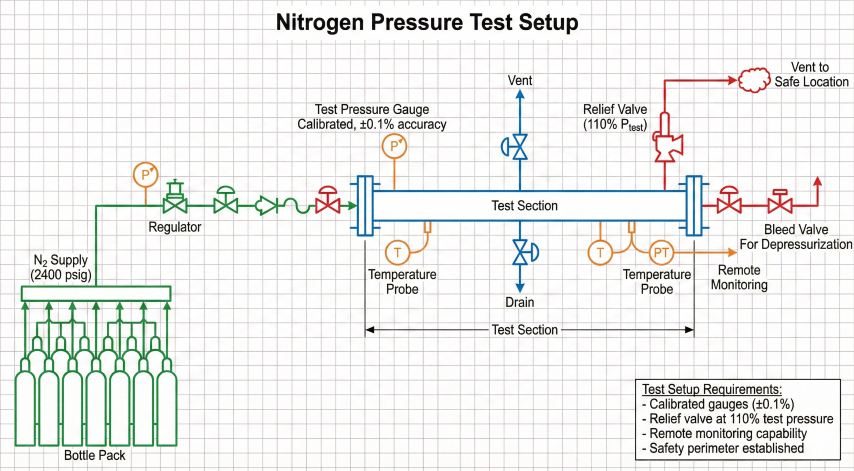
Nitrogen pressure test setup schematic showing pipeline test section with N2 bottle pack, regulator, test pressure gauge, temperature probes, relief valve, and vent to safe location
Nitrogen pressure test setup with supply manifold, instrumentation, and safety equipment

Strength Test

Verify Wall Integrity

Tests pipe body, welds, and fittings at pressures exceeding MAOP.

Leak Test

Detect Leakage

Identifies leaks at joints, valves, and connections at operating pressure.

Safety

Inert Gas

No fire/explosion risk compared to air testing for hydrocarbon service.

Practical

No Drying Required

Eliminates water disposal and pipeline drying procedures.

Regulatory Framework

Standard Scope Key Sections
ASME B31.8 Gas transmission & distribution §841.3, §845.2
49 CFR 192 Federal pipeline safety (DOT) §192.505-517
ASME B31.4 Liquid petroleum pipelines §437 (with approval)
API 1104 Pipeline welding Appendix A
When to use nitrogen testing: Preferred when hydrostatic testing is impractical: freezing climates, no water source, difficult water removal, or where oxygen (air testing) poses safety concerns with hydrocarbon residue.

2. Test Pressure Requirements

Test pressure depends on location class and intended MAOP per ASME B31.8 and 49 CFR Part 192.

ASME B31.8 Test Factors
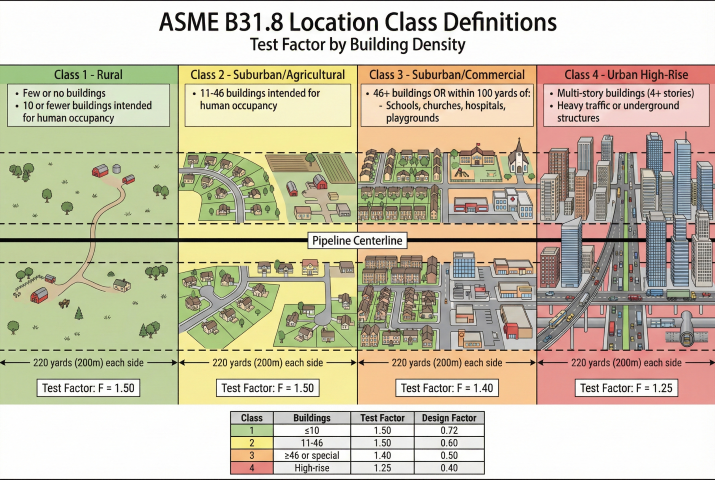
Strength Test Pressure (B31.8 §841.3.2): P_test = F × MAOP Where F = Test factor by location class: • Class 1 Division 1: F = 1.50 • Class 1 Division 2: F = 1.50 • Class 2: F = 1.50 • Class 3: F = 1.40 • Class 4: F = 1.25 Leak Test Pressure (B31.8 §845.2): P_leak ≥ 1.1 × MAOP (minimum)
ASME B31.8 location class definitions showing Class 1 rural through Class 4 urban high-rise based on building density within 220 yards of pipeline with corresponding test factors
ASME B31.8 location class definitions — test factor decreases as population density increases

Test Pressure Limits

Limiting Factor Maximum Test Pressure
Pipe body 100% SMYS (90% recommended)
Valves Cold working pressure (CWP) rating
Flanges (B16.5) Pressure rating at test temperature
Instruments Maximum rated pressure

Example: Test Pressure Calculation

Given: MAOP = 1000 psig Location: Class 1 Division 1 Pipe: 20" × 0.375" WT, X52 (SMYS = 52,000 psi) Step 1: Required test pressure P_test = 1.5 × 1000 = 1500 psig Step 2: Verify against SMYS limit Hoop stress at test: S = P × D / (2 × t) S = 1500 × 20 / (2 × 0.375) = 40,000 psi Percent SMYS = 40,000 / 52,000 = 76.9% ✓ Result: Test at 1500 psig for 8 hours minimum
Safety note: Pneumatic testing stores significant energy (E ∝ PV for gases). Follow ASME B31.8 Appendix N guidance: limit personnel access, install relief valves at 110% test pressure, use remote monitoring.

3. Nitrogen Volume Calculation

Nitrogen volume required depends on pipe volume, test pressure, and temperature. Calculations use real gas law for accuracy at high pressures.

Basic Formula
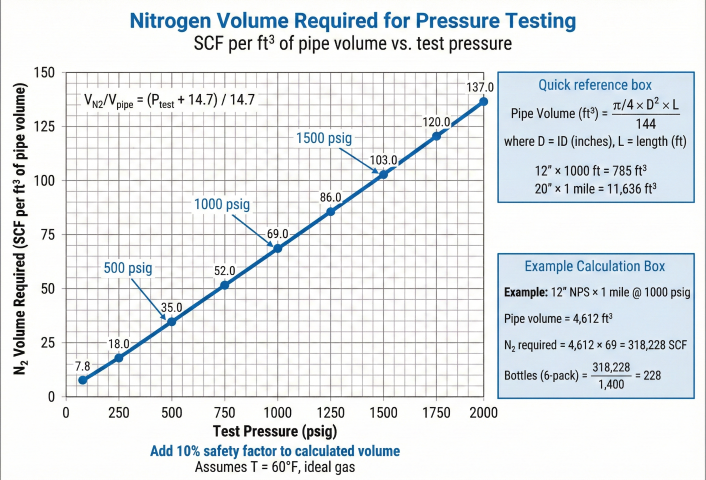
N₂ Volume at Standard Conditions: V_N2 = V_pipe × (P_test / P_std) × (T_std / T_ambient) × (Z_std / Z_test) Where: V_N2 = Nitrogen volume at standard conditions (SCF) V_pipe = Internal pipe volume (ft³) P_test = Test pressure absolute (psia) P_std = Standard pressure = 14.696 psia T_std = Standard temperature = 520°R (60°F) T_ambient = Pipeline temperature (°R) Z = Compressibility factor Pipe Internal Volume: V_pipe = π/4 × D_i² × L / 144 Where D_i = inside diameter (inches), L = length (feet)
Chart showing nitrogen volume required for pressure testing in SCF per cubic foot of pipe volume versus test pressure from 100 to 2000 psig with example calculation
N₂ volume required per ft³ of pipe volume vs. test pressure — add 10% safety factor

Standard Nitrogen Bottle Sizes

Container Volume (SCF) Pressure (psig) Typical Use
K-Cylinder 251 2,400 Small tests, makeup
T-Cylinder 330 2,640 Small tests
6-Pack 1,506 2,400 Medium tests
12-Pack 3,012 2,400 Medium-large tests
16-Pack 4,016 2,400 Large tests
Tube Trailer ~180,000 2,400 Major pipeline tests

Example: N₂ Bottle Calculation

Given: Pipe: 12" NPS × 1000 ft (ID ≈ 12.000") Test pressure: 500 psig (514.7 psia) Ambient temperature: 60°F (520°R) Step 1: Calculate pipe volume V_pipe = π/4 × 12² × 1000 / 144 = 785.4 ft³ Step 2: Calculate N₂ required (Z ≈ 1.0 at these conditions) V_N2 = 785.4 × (514.7 / 14.696) × (520 / 520) × 1.0 V_N2 = 785.4 × 35.02 = 27,507 SCF (theoretical) Step 3: Apply safety factor (10%) V_N2_total = 27,507 × 1.10 = 30,258 SCF Step 4: Determine bottles needed 6-Pack rated: 1,506 SCF; usable ≈ 1,434 SCF (100 psig residual) Bottles = 30,258 / 1,434 ≈ 22 six-packs Note: ~100 psig residual pressure left in bottles (not fully recoverable). Bottles rated at 70°F (CGA standard); adjust if stored at different temperature.

Compressibility Factor (Z)

Nitrogen behaves nearly ideally at pipeline test conditions (Tr > 2.0). Z stays close to 1.000 across the typical pressure range:

Pressure (psia) Z @ 60°F Z @ 100°F
14.7 (atm)1.0001.000
5000.9980.999
10000.9970.998
15000.9970.998
20000.9980.999
25001.0001.001

For most pipeline tests (P < 2000 psig), ideal gas assumption (Z = 1.0) is within 0.3% accuracy. The calculator applies a Pitzer correlation for Z automatically.

4. Temperature Corrections

Pneumatic test pressure varies significantly with temperature. Temperature corrections are essential to distinguish real leaks from thermal effects.

Temperature Correction Formula
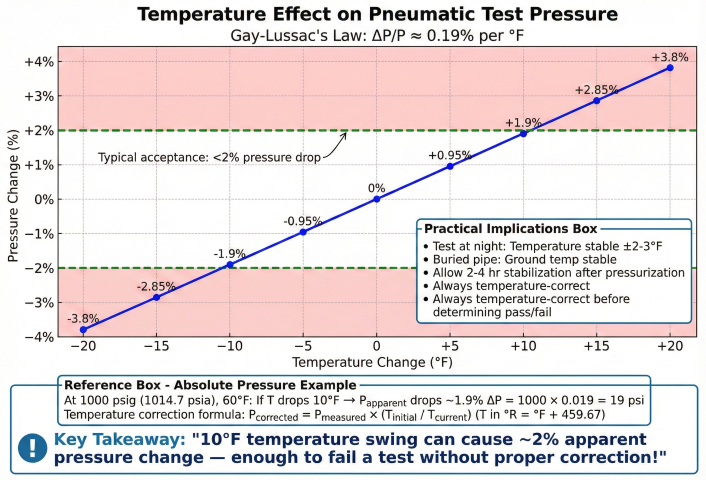
Gay-Lussac's Law (constant volume): P_corrected = P_measured × (T_initial / T_current) Where T in absolute units: °R = °F + 459.67 Pressure change per degree: ΔP/ΔT ≈ 0.20% per °F (at typical conditions) Example: 10°F temperature drop causes ~2% apparent pressure drop
Chart showing temperature effect on pneumatic test pressure per Gay-Lussac's Law with approximately 0.20 percent pressure change per degree Fahrenheit and acceptance criteria lines
Temperature effect on test pressure — 10°F swing causes ~2% apparent pressure change

Temperature Effect Magnitude

ΔT (°F) ΔP @ 1000 psig % Change
±1±2.0 psi±0.20%
±5±9.8 psi±1.0%
±10±19.5 psi±2.0%
±20±39 psi±3.9%

Example: Temperature Correction

Test Data: Initial: P₁ = 1500 psig, T₁ = 75°F After 4 hr: P₂ = 1465 psig, T₂ = 68°F Step 1: Convert to absolute T₁ = 75 + 459.67 = 534.67°R T₂ = 68 + 459.67 = 527.67°R Step 2: Apply temperature correction P₂_corrected = (1465 + 14.7) × (534.67/527.67) - 14.7 P₂_corrected = 1479.7 × 1.0133 - 14.7 = 1484.7 psig Step 3: Calculate actual pressure drop Apparent drop = 1500 - 1465 = 35 psi (2.3%) Actual drop = 1500 - 1484.7 = 15.3 psi (1.02%) Result: PASS (1.02% < 2% acceptance criterion) Without correction: Would have failed at 2.3%
Best practice: Record pressure and temperature every 15 minutes. Plot temperature-corrected pressure vs. time. A stable line indicates tight system; downward trend indicates leak.

Minimizing Temperature Effects

  • Buried pipe: Test after backfill—ground temperature stable within ±2-3°F
  • Night testing: Minimal solar heating, temperature more stable
  • Insulate exposed sections: Reduce radiative heating/cooling
  • Allow stabilization: Wait 2-4 hours after pressurization before starting hold time

5. Test Procedures

Pre-Test Checklist

  • Install test heads/blinds at section boundaries
  • Verify all valves, flanges, instruments rated for test pressure
  • Install calibrated pressure gauges (±0.1% accuracy) and temperature sensors
  • Set relief valves at 110% of test pressure
  • Open high-point vents, verify low-point drains accessible
  • Establish safety perimeter, brief personnel
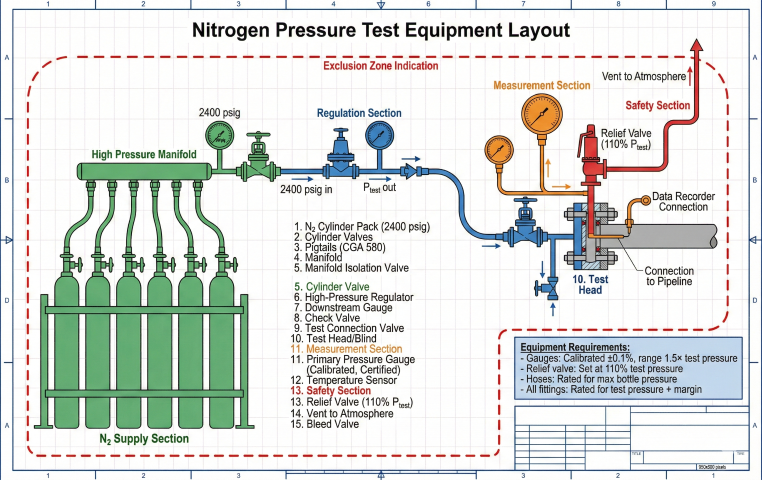
Detailed nitrogen pressure test equipment layout showing N2 cylinder pack, high-pressure manifold, regulator, test head connection, measurement section with calibrated gauges, and safety section with relief valve
Detailed N₂ test equipment layout with all components labeled per ASME B31.8 requirements

Pressurization Sequence

ASME B31.8 Pressurization Rate: Max rate: 100 psi/min (NPS ≤ 24), 50 psi/min (NPS > 24) Staged Pressurization: 1. Pressurize to 50% test pressure → Hold 15 min, inspect 2. Pressurize to 75% test pressure → Hold 15 min, inspect 3. Pressurize to 100% test pressure → Begin hold period

Hold Time Requirements

49 CFR 192.507 requires a minimum 1-hour hold for pneumatic strength tests. The extended hold times below are typical industry practice for leak detection and temperature stabilization:

Pipe Size (NPS) Typical Hold Time Extended (Best Practice)
≤ 4"4 hours4 hours
4" to 12"6 hours6-8 hours
12" to 24"8 hours8-12 hours
> 24"8 hours12-24 hours
HCA (High Consequence Area)8 hours24 hours

Acceptance Criteria

Test Type Acceptance Failure
Strength test No rupture, P drop <5% Rupture or excessive drop
Leak test No visible leaks, P drop <2% (temp corrected) Visible leaks or P drop >5%
HCA No detectable leaks, P drop <1% Any leak or P drop >2%

Depressurization

  • Maximum rate: 100 psi/min (NPS ≤ 12), 50 psi/min (NPS > 12)
  • Open high-point vents to prevent vacuum formation
  • Vent to safe location away from personnel (Joule-Thomson cooling at vent)
  • Monitor for freezing at vent discharge

Documentation Requirements

Per ASME B31.8 §841.3.4 and 49 CFR §192.517:

  • Pressure vs. time data (15-minute intervals minimum)
  • Temperature vs. time data at multiple points
  • Pipe specifications: NPS, WT, grade, SMYS
  • Test parameters: MAOP, test pressure, test factor, hold time
  • Gauge calibration certificates
  • Temperature-corrected results and acceptance determination
  • Signature of test supervisor and inspector
Safety reminder: Pneumatic tests have caused fatal accidents due to stored energy. Always follow safety protocols: restrict access, use remote monitoring, ensure relief protection, and never exceed 90% SMYS. Nitrogen displaces oxygen—monitor O₂ levels in confined spaces.