Pipeline Operations

Pipe Volume Calculations

Calculate internal pipe volume for inventory tracking, purging operations, hydrotesting requirements, and batching calculations using diameter, length, and standard volume-per-foot factors.

Volume per foot

0.0408 × d² gal/ft

Gallons per foot: 0.0408 × d² where d = ID (inches). Quick reference for inventory.

Typical example

12" pipe: 5.88 gal/ft

12" NPS pipe contains 5.88 gallons per foot (or 0.140 barrels/ft, 0.785 ft³/ft).

Gas inventory

P/P_std × V_pipe

Gas volume at pressure: multiply pipe volume by pressure ratio (P/14.7) for scf inventory.

Quick start

Try the calculator

Calculate pipe volume for inventory, hydrotesting, or purging operations in your pipeline.

Open calculator →

1. Volume Calculation

Pipe internal volume is calculated from the inside diameter and length. Various unit conversions are needed for practical applications.

Basic Formulas
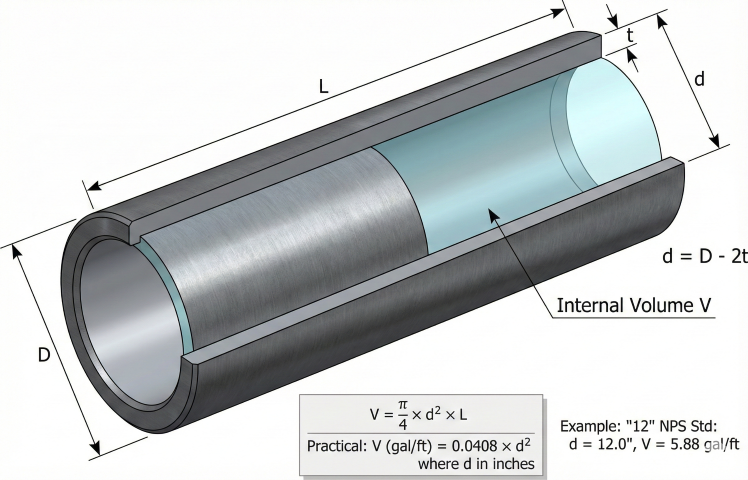
Volume per foot of pipe: V = π × d² / 4 × (1 ft) Practical formulas: V (gal/ft) = 0.0408 × d² V (bbl/ft) = 0.000971 × d² V (ft³/ft) = 0.00545 × d² V (liters/m) = 0.7854 × d² [d in cm] Where d = inside diameter (inches)
3D cutaway of pipe section showing outside diameter D, inside diameter d, wall thickness t, length L, and highlighted internal volume with formula V = π/4 × d² × L
Pipe volume geometry: Internal volume depends on inside diameter squared; d = D - 2t accounts for wall thickness.

Inside Diameter

d = D - 2t Where: d = Inside diameter (inches) D = Outside diameter (inches) t = Wall thickness (inches)

Unit Conversions

From To Multiply by Source
ft³ US gallons 7.480519 API MPMS
ft³ barrels (42 gal) 0.178108 API
gallons barrels 0.023810 API
ft³ liters 28.31685 NIST
gallons liters 3.785412 NIST
barrels liters 158.987 API

2. Volume Reference Tables

Standard Pipe Volumes

NPS OD (in) Wall (Std) ID (in) gal/ft bbl/mile
2" 2.375 0.154 2.067 0.174 21.9
4" 4.500 0.237 4.026 0.661 83.4
6" 6.625 0.280 6.065 1.501 189.4
8" 8.625 0.322 7.981 2.599 327.9
10" 10.750 0.365 10.020 4.098 517.0
12" 12.750 0.375 12.000 5.875 741.2
16" 16.000 0.375 15.250 9.489 1,197
20" 20.000 0.375 19.250 15.12 1,907
24" 24.000 0.375 23.250 22.05 2,782
30" 30.000 0.375 29.250 34.90 4,403
36" 36.000 0.375 35.250 50.71 6,398
42" 42.000 0.500 41.000 68.60 8,655

Quick Reference: Volume per Mile

Volume per mile: V (gal/mile) = 0.0408 × d² × 5,280 = 215.4 × d² V (bbl/mile) = 5.129 × d² Example: 24" × 0.500" wall (ID = 23") V = 5.129 × 23² = 2,715 bbl/mile

3. Gas Volume at Pressure

For gas pipelines, volume must account for compressibility. The actual gas quantity depends on pressure, temperature, and gas composition.

Gas Inventory Calculation

Standard cubic feet in pipeline: SCF = V_pipe × (P / P_std) × (T_std / T) × (Z_std / Z) Where: V_pipe = Physical pipe volume (ft³) P = Operating pressure (psia) P_std = Standard pressure (14.7 psia) T = Operating temperature (°R) T_std = Standard temperature (519.67°R = 60°F) Z = Compressibility factor at operating conditions Z_std = 1.0 (ideal gas at standard conditions) Simplified (per AGA conventions): SCF = V_pipe × P × 35.34 / (T × Z)

Z-Factor Estimation

The compressibility factor Z accounts for real gas behavior. For natural gas:

Sutton (1985) pseudo-critical correlations: T_pc = 169.2 + 349.5×SG - 74.0×SG² [°R] P_pc = 756.8 - 131.0×SG - 3.6×SG² [psia] Reduced properties: T_pr = T / T_pc P_pr = P / P_pc Typical Z values (SG = 0.60): • 500 psia, 60°F: Z ≈ 0.92 • 1000 psia, 60°F: Z ≈ 0.84 • 1500 psia, 60°F: Z ≈ 0.78

Line Pack Formula

Line pack (MMSCF): LP = 28.31 × d² × L × P_avg / (1,000,000 × T × Z) Where: d = Inside diameter (inches) L = Length (miles) P_avg = Average pressure (psia) T = Average temperature (°R) Z = Average compressibility factor Quick estimate (ideal gas): LP ≈ d² × L × P_avg / 1,000,000 [MMSCF]

Example: Gas Pipeline Inventory

Given: 24" × 0.500" wall, 100 miles, P_avg = 800 psia, T = 70°F, SG = 0.60

Step 1: Physical volume
ID = 24 - 2(0.500) = 23 in
V = 0.00545 × 23² × 5,280 × 100 = 15.23 MM ft³

Step 2: Z-factor (from DAK correlation)
T_pc = 169.2 + 349.5(0.60) - 74.0(0.36) = 352.5°R
P_pc = 756.8 - 131.0(0.60) - 3.6(0.36) = 676.8 psia
T_pr = 530/352.5 = 1.50; P_pr = 800/676.8 = 1.18
Z ≈ 0.87

Step 3: Line pack
SCF = 15.23×10⁶ × 800 × 35.34 / (530 × 0.87)
SCF = 934 MMSCF

Operating significance: Line pack represents stored gas that can be withdrawn by lowering pressure. A 100 psi pressure swing in this example releases/absorbs approximately 115-120 MMSCF—critical for balancing supply and demand.

4. Applications

Common Uses

Application Purpose
Hydrotesting Calculate water volume needed for test
Purging/inerting Determine nitrogen volume for displacement
Pigging Estimate pig travel time at given flow rate
Batch tracking Calculate batch interface location
Line pack Gas storage capacity in pipeline
Blowdown Gas release volume for depressuring
Chemical treatment Inhibitor/biocide dosing volume

Hydrotest Water Requirements

Water volume: V_water = V_pipe × (1 + compression factor) Compression factor ≈ 0.03 per 1000 psi test pressure (Water compresses ~3% at 1000 psi) Fill time estimate: t (hours) = V_pipe (gal) / Q_fill (gal/hr)

Pig Travel Time

Travel time: t = V_pipe / Q For liquids: t (hours) = V (bbl) / Q (bbl/hr) t (hours) = L (miles) × 5.129 × d² / Q (bbl/hr) For gas (at flow velocity): t (hours) = L (miles) × 5,280 / (v × 3,600) Where v = gas velocity (ft/s)

5. System Volume

Total system volume includes pipe plus vessels, headers, and fittings.

Vessel Volumes

Horizontal cylinder: V = π × D² × L / 4 Sphere: V = π × D³ / 6 2:1 Elliptical head: V_head = 0.1309 × D³ (each head) Hemispherical head: V_head = π × D³ / 12 (each head)

Fitting Equivalent Volumes

Fitting Equivalent Pipe Length
90° elbow (LR) 1.5 × D
90° elbow (SR) 1.0 × D
45° elbow 0.7 × D
Tee (through) 1.0 × D
Tee (branch) 1.5 × D
Gate valve (open) 0.5 × D
Ball valve (open) 0.1 × D

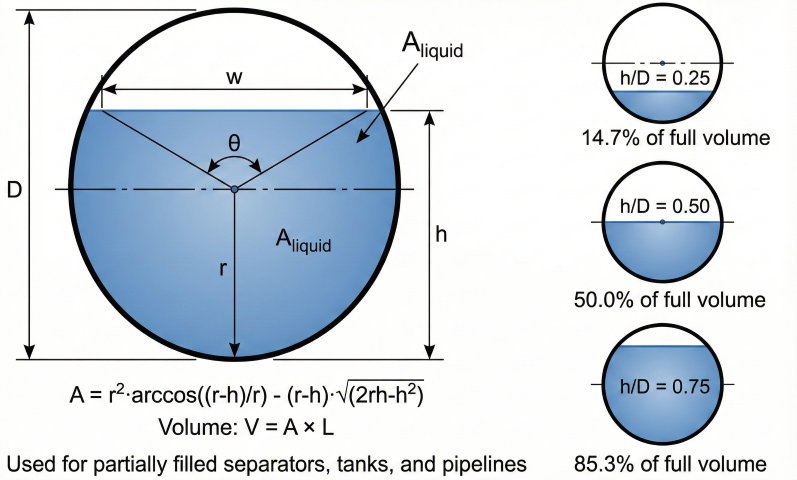
Partially Filled Horizontal Pipe

Cross-sectional area at depth h: A = r² × arccos((r-h)/r) - (r-h) × √(2rh - h²) Volume: V = A × L Quick reference (% of full): h/D = 0.25 → V = 14.7% of full h/D = 0.50 → V = 50.0% of full h/D = 0.75 → V = 85.3% of full Where: r = D/2 (radius), h = liquid depth from bottom
Horizontal pipe cross-section showing partial fill calculation with radius r, liquid depth h, chord width w, and angle θ, plus three reference diagrams at 25%, 50%, and 75% fill levels
Partial volume: 25% fill = 14.7% volume, 50% fill = 50% volume, 75% fill = 85.3% volume; used for separator and tank gauging.

References

  • ASME B36.10M – Welded and Seamless Wrought Steel Pipe
  • API MPMS Chapter 11.1 – Temperature and Pressure Volume Correction
  • AGA Report No. 8 – Compressibility and Supercompressibility Factors
  • GPSA, Section 17 – Fluid Properties
  • Dranchuk & Abou-Kassem (1975) – Z-Factor Calculation Methods
  • Sutton (1985) – Pseudo-Critical Property Correlations