1. Hammerschmidt Equation
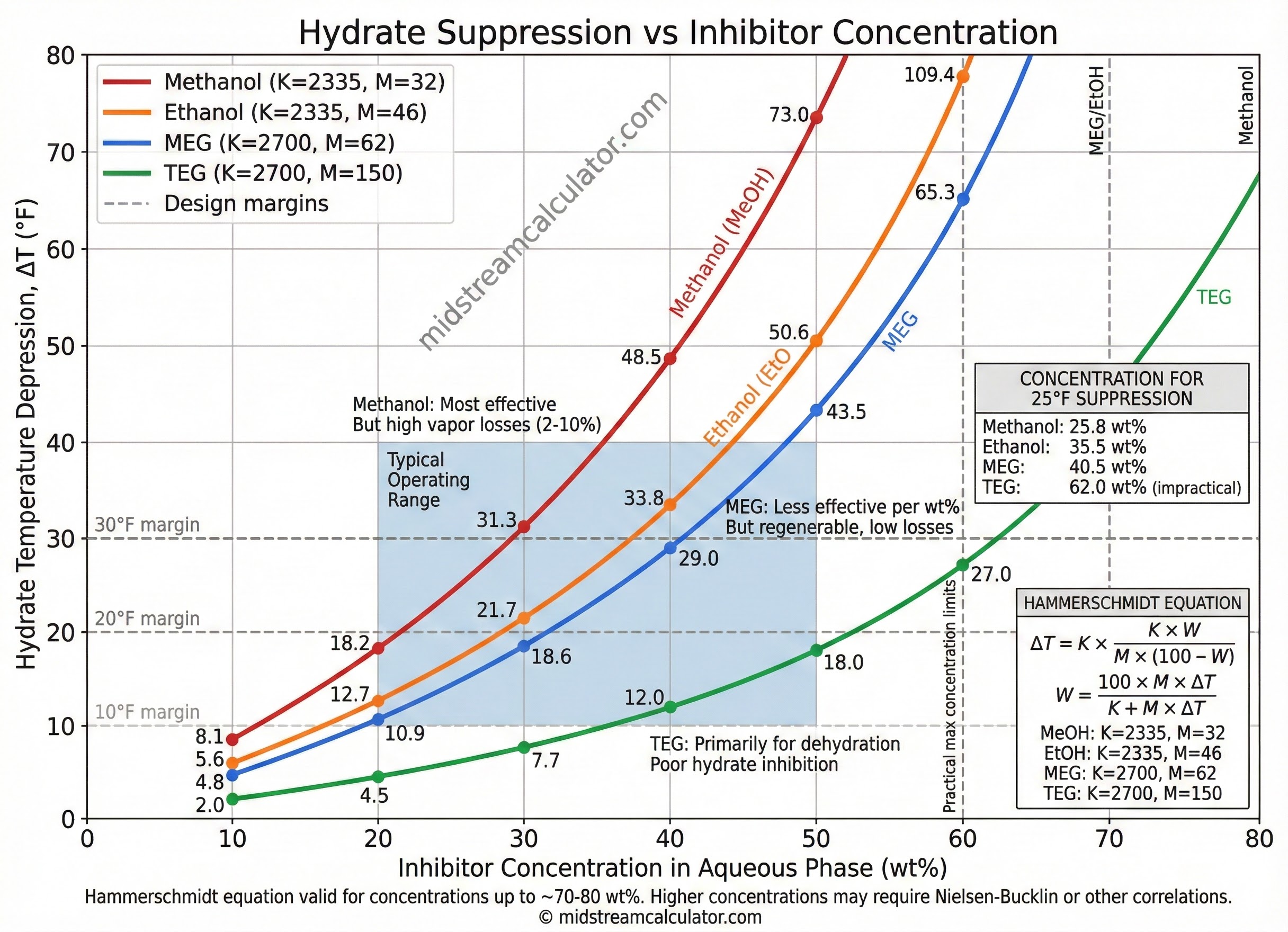
Predicts hydrate temperature depression based on inhibitor concentration in the aqueous phase.
Hammerschmidt Equation:
ΔT = K × W / (M × (100 - W))
Solved for concentration:
W = 100 × M × ΔT / (K + M × ΔT)
Where:
ΔT = Hydrate temperature depression (°F)
K = 2,335 (universal Hammerschmidt constant, °F form)
W = Weight % inhibitor in aqueous phase (0-100)
M = Molecular weight of inhibitor (g/mol)
Inhibitor Constants
| Inhibitor | MW | K | Max W | ΔT @ 25 wt% |
|---|---|---|---|---|
| Methanol | 32.04 | 2,335 | ~80% | 24.3°F |
| Ethanol | 46.07 | 2,335 | ~70% | 16.9°F |
| MEG | 62.07 | 2,335 | ~70% | 12.5°F |
| DEG | 106.12 | 2,335 | ~65% | 7.3°F |
| TEG | 150.17 | 2,335 | ~60% | 5.2°F |
Example: Methanol Concentration
Given: Need 30°F hydrate suppression using methanol
K = 2,335, M = 32.04
W = 100 × 32.04 × 30 / (2,335 + 32.04 × 30)
= 96,120 / 3,296
= 29.2 wt% methanol in aqueous phase
2. Methanol Injection
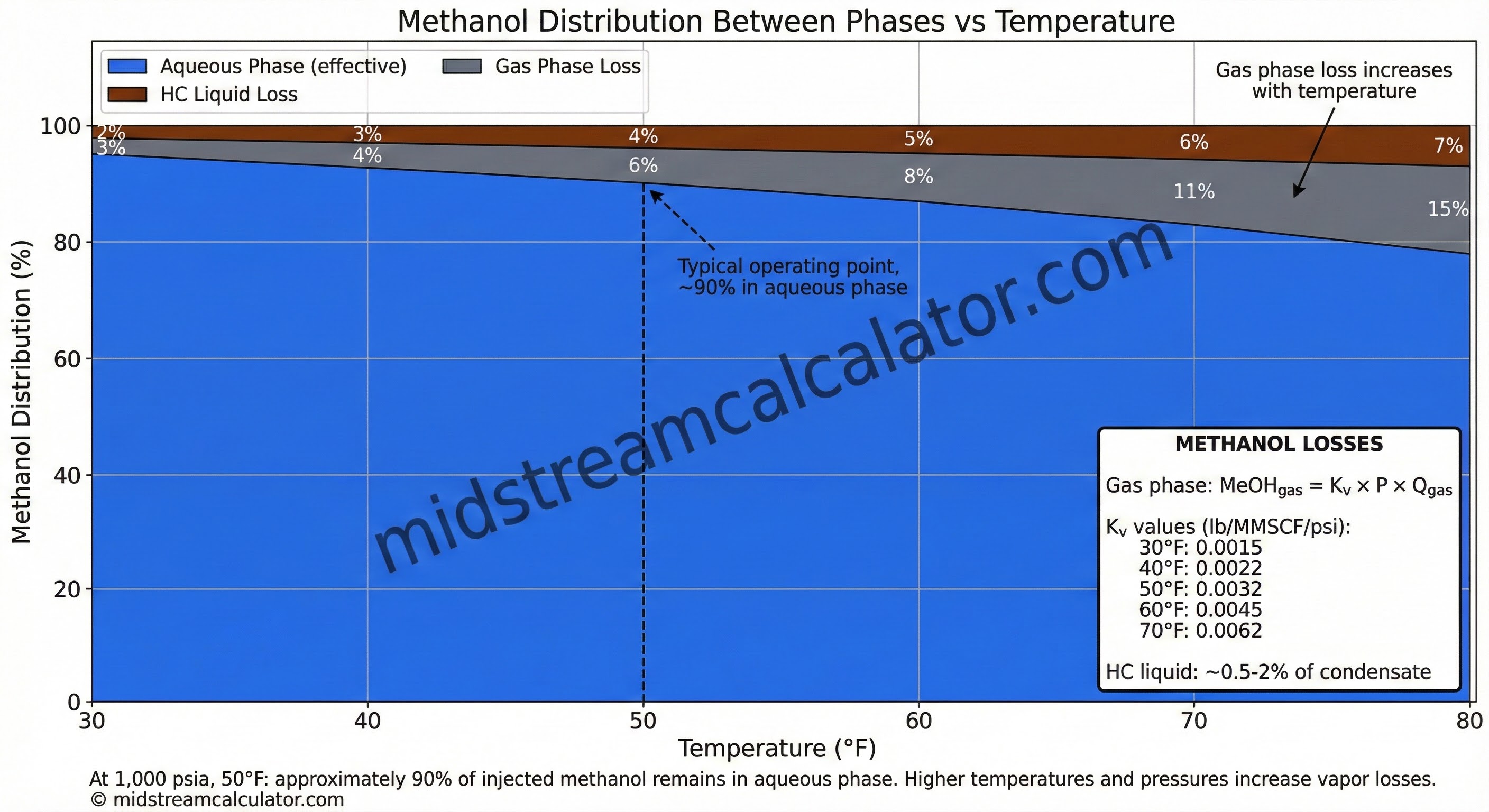
Methanol is effective but lost to both gas and liquid hydrocarbon phases. Total requirement = aqueous + gas losses + HC losses.
Total methanol requirement:
MeOH_total = MeOH_water + MeOH_gas + MeOH_HC
In aqueous phase (Hammerschmidt):
MeOH_water = W × W_rate / (100 - W) [lb/day]
Lost to gas phase:
MeOH_gas = Kᵥ × P × Q_gas [lb/day]
Where Kᵥ = vapor distribution factor (see table)
Lost to hydrocarbon liquid:
MeOH_HC ≈ 0.5-2% of condensate volume
Methanol Vapor Loss Factor (Kᵥ)
| T (°F) | 30 | 40 | 50 | 60 | 70 |
|---|---|---|---|---|---|
| Kᵥ (lb/MMSCF/psi) | 0.0015 | 0.0022 | 0.0032 | 0.0045 | 0.0062 |
Example: Methanol Injection Rate
Given: 10 MMSCFD, 50 bbl/day water, 1000 psia, 40°F
Need 25 wt% MeOH in water
Water mass: 50 bbl × 350 lb/bbl = 17,500 lb/day
MeOH in water:
= 0.25 × 17,500 / (1 - 0.25) = 5,833 lb/day
MeOH to gas (Kᵥ = 0.0022 at 40°F):
= 0.0022 × 1000 × 10 = 22 lb/day
Total: 5,855 lb/day ÷ 6.6 lb/gal = 887 gal/day (21 bbl/day)
⚠ Safety: Methanol is toxic and flammable. Follow applicable handling codes.
3. Glycol (MEG) Injection
Glycols are preferred for pipelines because they're regenerable with minimal vapor losses.
MEG vs Methanol
| Factor | Methanol | MEG |
|---|---|---|
| Effectiveness (ΔT per wt%) | Higher | Lower |
| Recovery | Usually lost | Regenerated (80-90%) |
| Vapor loss | 2-10% | <0.1% |
| HC solubility loss | 1-2% | <0.5% |
| Cost driver | Operating (makeup) | Capital (regen unit) |
| Best application | Short-term, remote | Long pipelines, offshore |
Glycol Injection Calculation
Lean glycol injection rate:
G_lean = W_water × C_rich / (C_lean - C_rich)
Rich glycol concentration:
C_rich = 100 × M × ΔT / (2,335 + M × ΔT) [from Hammerschmidt]
Where:
G_lean = Lean glycol rate (lb/day)
W_water = Water production (lb/day)
C_lean = Lean glycol concentration (typically 80-90 wt%)
C_rich = Rich glycol concentration (from required ΔT)
K = 2,335 (universal constant, °F)
Example: MEG Injection Rate
Given: 100 bbl/day water, need 25°F suppression
Lean MEG = 85 wt%, M = 62.07, K = 2,335
Rich MEG concentration (Hammerschmidt):
C_rich = 100 × 62.07 × 25 / (2,335 + 62.07 × 25)
= 155,175 / 3,887 = 39.9 wt%
Water mass: 100 bbl × 350 lb/bbl = 35,000 lb/day
Lean MEG rate:
G_lean = 35,000 × 39.9 / (85 - 39.9)
= 1,396,500 / 45.1 = 30,965 lb/day
Volume: 30,965 lb ÷ 9.3 lb/gal = 3,330 gal/day (79 bbl/day)
4. Corrosion Inhibitors
Film-forming corrosion inhibitors protect against CO₂ and H₂S attack. Dosing is typically ppm-based on produced water volume.
Dosing Rates
| Application | Typical Rate (ppm) |
|---|---|
| Sweet gas (CO₂ only) | 10-25 |
| Sour gas (H₂S present) | 25-50 |
| High CO₂ (>5 mol%) | 50-100 |
| Produced water systems | 25-75 |
Injection Rate Calculation
Continuous injection:
Rate (gal/day) = Q_water (bbl/day) × ppm × 42 / (ρ × 10⁶)
Where:
Q_water = Water production rate (bbl/day)
ppm = Target concentration
ρ = Inhibitor density (lb/gal), typically 8-9
42 = gal/bbl
Example:
500 bbl/day water, 50 ppm, ρ = 8.5 lb/gal
Rate = 500 × 50 × 42 / (8.5 × 10⁶) = 0.12 gal/day
References
- GPSA, Section 20
- NACE SP0106 – Internal Corrosion Control
- API RP 14E – Offshore Platform Piping
Ready to use the calculator?
→ Launch Calculator