Master PV=nRT fundamentals, gas constant R in different units, combined gas law, partial pressure calculations using Dalton's law, and determining when ideal gas applies versus real gas behavior.
Determine when to use ideal versus real gas equations.
1. Overview & PV=nRT
The ideal gas law is the most fundamental equation in gas engineering, relating pressure, volume, temperature, and quantity of gas. It assumes gas molecules have no volume and no intermolecular forces—a good approximation at low pressures and high temperatures.
Ideal gas assumptions
Point particles
Molecules are infinitely small points with no volume; only kinetic energy matters.
No interactions
Elastic collisions
No attractive or repulsive forces between molecules; collisions are perfectly elastic.
Applications
Preliminary design
Use for screening calculations, low-pressure systems, and when precision <5% is acceptable.
Limitations
High P, low T
Fails at high pressure (>500 psia) or near liquefaction; use real gas equations with Z-factor.
The Ideal Gas Law
Fundamental Form:
PV = nRT
Where:
P = Absolute pressure (psia, Pa, bar)
V = Volume (ft³, m³, liters)
n = Number of moles (lbmol, mol, kmol)
R = Universal gas constant
T = Absolute temperature (°R = °F + 459.67, K = °C + 273.15)
CRITICAL: All pressures must be absolute (gauge + atmospheric)
CRITICAL: All temperatures must be absolute (°R or K, never °F or °C)
Derivation and Physical Meaning
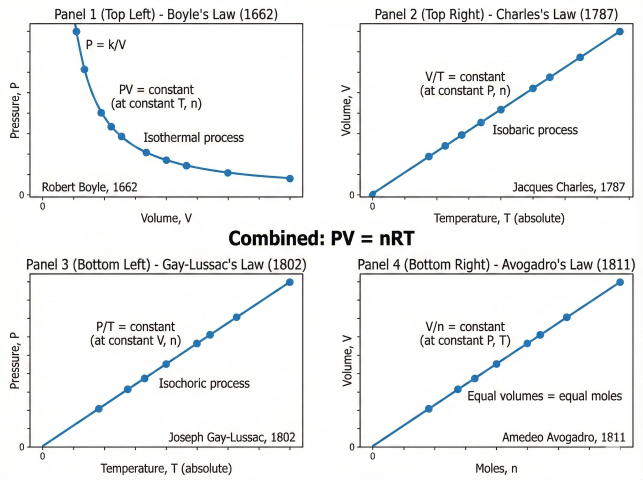
The ideal gas law combines three empirical gas laws discovered in the 17th-19th centuries:
The four component gas laws that combine into the ideal gas law PV = nRT: Boyle (1662), Charles (1787), Gay-Lussac (1802), and Avogadro (1811).
Boyle's Law (1662): PV = constant at constant T and n (inverse relationship)
Charles's Law (1787): V/T = constant at constant P and n (direct proportionality)
Gay-Lussac's Law (1802): P/T = constant at constant V and n
Avogadro's Law (1811): V/n = constant at constant P and T (equal volumes contain equal moles)
Combined into Ideal Gas Law:
(P₁V₁) / (n₁T₁) = (P₂V₂) / (n₂T₂) = R (constant)
Physical interpretation:
- Pressure from molecular collisions with walls
- Volume available for molecular motion
- Temperature measures average kinetic energy (KE = (3/2)kT)
- Moles count number of molecules (via Avogadro's number)
At microscopic level:
Pressure × Volume = (Number of molecules) × (Average kinetic energy)
Alternative Forms of Ideal Gas Law
Form
Equation
Use When
Molar form
PV = nRT
Given number of moles
Mass form
PV = (m/MW) RT
Given mass and molecular weight
Density form
P = ρRT/MW
Calculating gas density
Specific volume form
Pv = RT/MW
Using specific volume (v = V/m)
Number of molecules form
PV = NkT
Microscopic analysis (k = Boltzmann constant)
Common Applications
Volume conversions: Convert standard volume to actual volume at operating conditions
Density calculations: Calculate gas density at specified P/T for flow rate calculations
Tank sizing: Determine vessel volume required to hold specified mass of gas
Pressure vessel design: Predict pressure rise from temperature increase in closed vessel
Pneumatic systems: Size air receivers and calculate compressor capacity
Process simulations: Preliminary calculations before applying rigorous thermodynamics
Critical reminder: The most common error in ideal gas law calculations is using gauge pressure instead of absolute pressure, or using °F/°C instead of absolute temperature. ALWAYS convert: P_abs = P_gauge + 14.7 psia, T_abs (°R) = T(°F) + 459.67, T_abs (K) = T(°C) + 273.15.
Example Calculation
Problem: Calculate volume of 10 lbmol methane at 500 psig, 80°F
Given:
n = 10 lbmol
P = 500 psig (gauge pressure)
T = 80°F
Step 1: Convert to absolute units
P_abs = 500 + 14.7 = 514.7 psia
T_abs = 80 + 459.67 = 539.67 °R
Step 2: Select gas constant
R = 10.73 psia·ft³/(lbmol·°R)
Step 3: Apply ideal gas law
PV = nRT
V = nRT / P = 10 × 10.73 × 539.67 / 514.7
V = 57,914 / 514.7 = 112.5 ft³
Result: 10 lbmol methane occupies 112.5 ft³ at 500 psig, 80°F (ideal gas assumption)
Check: This is ideal gas volume. For real gas at 500 psia, Z ≈ 0.95,
so actual volume ≈ 112.5 / 0.95 = 118.4 ft³ (5% error from ideal)
2. Gas Constant R
The universal gas constant R relates energy, temperature, and quantity of gas. Its numerical value depends on the unit system used. Selecting the correct R value is essential for accurate calculations.
Universal Gas Constant Values
Unit System
R Value
Units
Common Usage
US Engineering (petroleum)
10.73
psia·ft³/(lbmol·°R)
Oil & gas industry standard
SI (international)
8.314
J/(mol·K) or kPa·m³/(kmol·K)
International standard
SI (alternative)
8314
J/(kmol·K)
Using kilomoles
CGS units
82.06
atm·cm³/(mol·K)
Laboratory chemistry
Energy form
1.987
Btu/(lbmol·°R) or cal/(mol·K)
Thermochemistry
US alternative
1545
ft·lbf/(lbmol·°R)
Mechanical engineering
Selecting the Correct R Value
R Selection Guide:
Match R units to your calculation units:
For P in psia, V in ft³, T in °R, n in lbmol:
→ Use R = 10.73 psia·ft³/(lbmol·°R)
For P in kPa, V in m³, T in K, n in kmol:
→ Use R = 8.314 kPa·m³/(kmol·K)
For P in bar, V in L, T in K, n in mol:
→ Use R = 0.08314 bar·L/(mol·K)
For P in atm, V in L, T in K, n in mol:
→ Use R = 0.08206 atm·L/(mol·K)
RULE: Check dimensional analysis!
PV = nRT must yield consistent units on both sides.
Example: psia × ft³ = lbmol × [psia·ft³/(lbmol·°R)] × °R ✓
Relationship to Other Constants
Gas Constant Relationships:
Universal gas constant:
R = N_A × k_B
Where:
N_A = Avogadro's number = 6.022 × 10²³ molecules/mol
k_B = Boltzmann constant = 1.381 × 10⁻²³ J/K
R relates to specific heat:
Cp - Cv = R (for ideal gas)
Where:
Cp = Molar heat capacity at constant pressure
Cv = Molar heat capacity at constant volume
For monatomic ideal gas (He, Ar):
Cv = (3/2)R, Cp = (5/2)R, k = Cp/Cv = 1.67
For diatomic ideal gas (N₂, O₂):
Cv = (5/2)R, Cp = (7/2)R, k = 1.40
Specific Gas Constant
For calculations using mass instead of moles, define specific gas constant:
Specific Gas Constant (R_specific):
R_specific = R_universal / MW
Where:
MW = Molecular weight (lb/lbmol or g/mol)
Example for methane (MW = 16.04):
R_CH4 = 10.73 / 16.04 = 0.669 psia·ft³/(lb·°R)
Ideal gas law becomes:
PV = m × R_specific × T
Where m = mass (lb or kg)
For air (MW = 28.97):
R_air = 10.73 / 28.97 = 0.370 psia·ft³/(lb·°R)
R_air = 287 J/(kg·K) [SI units]
Unit Conversions for R
From
To
Conversion Factor
10.73 psia·ft³/(lbmol·°R)
8.314 J/(mol·K)
Divide by 1.29
10.73 psia·ft³/(lbmol·°R)
1545 ft·lbf/(lbmol·°R)
Multiply by 144
8.314 J/(mol·K)
8.314 kPa·m³/(kmol·K)
Identical (1 J = 1 kPa·m³)
8.314 J/(mol·K)
0.08314 bar·L/(mol·K)
Divide by 100
Best practice: In US petroleum engineering, always use R = 10.73 psia·ft³/(lbmol·°R) with P in psia (absolute), V in ft³, n in lbmol, and T in °R. This is the industry standard. For international work, use R = 8.314 kPa·m³/(kmol·K) with SI units. Never mix unit systems in a single calculation.
Example: Verifying R Value
Problem: Verify ideal gas law using known conditions
Standard conditions: 1 lbmol occupies 379.4 ft³ at 14.7 psia, 60°F
Calculate R:
PV = nRT
R = PV / (nT)
Given:
P = 14.7 psia
V = 379.4 ft³
n = 1 lbmol
T = 60 + 459.67 = 519.67 °R
R = (14.7 × 379.4) / (1 × 519.67)
R = 5,577 / 519.67
R = 10.73 psia·ft³/(lbmol·°R) ✓
This confirms the standard value of R = 10.73 in US units.
Standard Molar Volume
At standard conditions, the molar volume is constant for all ideal gases:
Molar Volume at Standard Conditions:
US petroleum standard (14.73 psia, 60°F):
V_molar = 379.4 ft³/lbmol
STP (Standard Temperature and Pressure: 14.7 psia, 32°F):
V_molar = 359.0 ft³/lbmol
ISO standard (101.325 kPa, 15°C):
V_molar = 23.64 m³/kmol
Universal STP (1 atm, 0°C):
V_molar = 22.41 L/mol
These values allow quick conversions:
Q (scf) = n (lbmol) × 379.4 ft³/lbmol [at petroleum standard conditions]
3. Combined Gas Law
The combined gas law applies ideal gas principles to state changes: converting gas from one set of conditions (P₁, V₁, T₁) to another (P₂, V₂, T₂) when the amount of gas (n) remains constant.
Combined Gas Law Equation
Combined Gas Law (constant n):
(P₁V₁) / T₁ = (P₂V₂) / T₂
Where:
P₁, V₁, T₁ = Initial pressure (absolute), volume, temperature (absolute)
P₂, V₂, T₂ = Final pressure (absolute), volume, temperature (absolute)
This equation applies when the number of moles n is constant
(closed system, no gas added or removed).
Derived from ideal gas law:
PV = nRT → PV/T = nR = constant
Special Cases
Law
Constant Parameters
Equation
Application
Boyle's Law
T, n constant
P₁V₁ = P₂V₂
Isothermal compression/expansion
Charles's Law
P, n constant
V₁/T₁ = V₂/T₂
Isobaric heating/cooling
Gay-Lussac's Law
V, n constant
P₁/T₁ = P₂/T₂
Isochoric pressure vessel heating
Combined Gas Law
n constant
(P₁V₁)/T₁ = (P₂V₂)/T₂
General state change
Volume Conversion (Most Common Application)
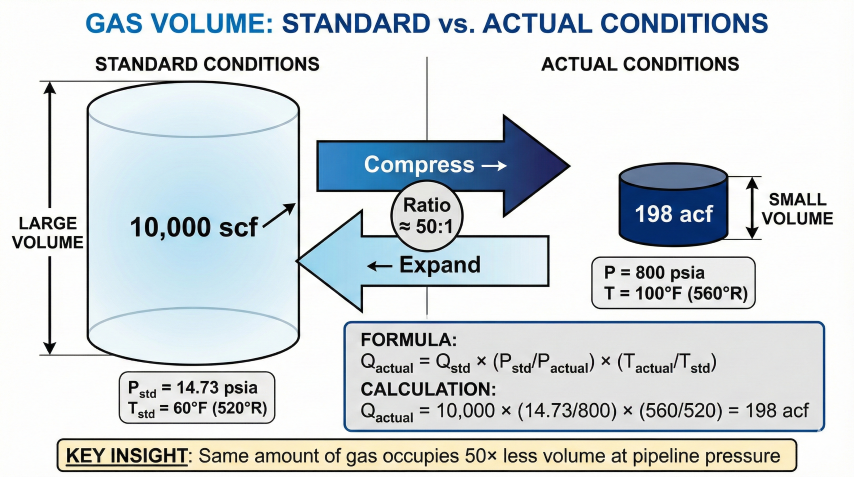
Standard vs. actual volume: same gas mass occupies 50× less volume at pipeline pressure. Q_actual = Q_std × (P_std/P_actual) × (T_actual/T_std).
Standard to Actual Volume Conversion:
Q_actual = Q_std × (P_std / P_actual) × (T_actual / T_std)
Where:
Q_std = Volumetric flow rate at standard conditions (scfh, scfm, scfd)
Q_actual = Volumetric flow rate at actual conditions (acfh, acfm, acfd)
P_std = Standard pressure (14.73 psia for petroleum)
P_actual = Actual pressure (psia)
T_std = Standard temperature (60°F = 520°R for petroleum)
T_actual = Actual temperature (°R)
Example:
Q_std = 10 MMscfd at 14.73 psia, 60°F
Actual conditions: 800 psia, 100°F
Q_actual = 10 MMscfd × (14.73/800) × (560/520)
Q_actual = 10 × 0.0184 × 1.077 = 0.198 MMacfd = 198 Macfd
Gas compressed from 10 million ft³/day at standard to 198,000 ft³/day actual.
Pressure Vessel Temperature Rise
When a closed pressure vessel is heated, pressure increases according to Gay-Lussac's law:
Pressure Rise in Closed Vessel:
P₂ = P₁ × (T₂ / T₁)
Example: Pressure vessel charged to 500 psig at 70°F
If heated to 150°F by fire exposure, what is the pressure?
P₁ = 500 + 14.7 = 514.7 psia
T₁ = 70 + 459.67 = 529.67 °R
T₂ = 150 + 459.67 = 609.67 °R
P₂ = 514.7 × (609.67 / 529.67) = 592.4 psia = 577.7 psig
Pressure increased by 15% (78 psi) due to 80°F temperature rise.
This is why pressure relief valves must protect against fire scenarios!
Practical Example: Compressed Air Tank
Problem: Air receiver charged at 85°F to 125 psig.
After cooling overnight to 55°F, what is the pressure?
Given:
Initial: P₁ = 125 + 14.7 = 139.7 psia, T₁ = 85 + 459.67 = 544.67 °R
Final: T₂ = 55 + 459.67 = 514.67 °R
Volume constant (rigid tank)
Apply Gay-Lussac's law:
P₂ = P₁ × (T₂ / T₁)
P₂ = 139.7 × (514.67 / 544.67)
P₂ = 139.7 × 0.945 = 132.0 psia
P₂ = 132.0 - 14.7 = 117.3 psig
Tank pressure dropped from 125 psig to 117 psig (6% reduction) due to 30°F
temperature decrease. Operator may think there is a leak, but it's just
thermal contraction. Always consider temperature when evaluating pressure changes!
Molecular Weight Calculations
Molecular weight can be calculated from measured P, V, T, and mass:
Molecular Weight from PVT Data:
PV = (m/MW) × R × T
Solving for MW:
MW = (m × R × T) / (P × V)
Where m = mass of gas sample
Example: Unknown gas sample
Mass: 100 lb
Pressure: 50 psia
Volume: 100 ft³
Temperature: 70°F = 530°R
MW = (100 × 10.73 × 530) / (50 × 100)
MW = 568,690 / 5,000 = 113.7 lb/lbmol
This MW suggests a heavy hydrocarbon mixture (pentane MW=72, hexane MW=86,
or blend with heavier components).
Critical insight: The combined gas law reveals that gas volume is inversely proportional to pressure but directly proportional to absolute temperature. Doubling absolute pressure halves volume (Boyle). Doubling absolute temperature doubles volume (Charles). For accurate conversions, always use absolute units—never gauge pressure or °F/°C directly.
Example: Pipeline Volume Conversion
Problem: 20-mile pipeline (16" ID) contains gas at 900 psia, 75°F.
Calculate standard volume (scf) at 14.73 psia, 60°F.
Step 1: Calculate pipeline volume
D = 16" = 1.333 ft
L = 20 miles = 105,600 ft
V = π/4 × D² × L = 0.785 × 1.333² × 105,600 = 147,400 ft³
Step 2: Apply combined gas law
V_std = V_actual × (P_actual / P_std) × (T_std / T_actual)
P_actual = 900 psia, T_actual = 75 + 459.67 = 534.67 °R
P_std = 14.73 psia, T_std = 60 + 459.67 = 519.67 °R
V_std = 147,400 × (900 / 14.73) × (519.67 / 534.67)
V_std = 147,400 × 61.1 × 0.972 = 8.76 million scf
Pipeline contains 8.76 MMscf of gas at standard conditions.
At $3.00/Mscf, line pack value = $26,280.
4. Dalton's Law & Partial Pressures
Dalton's law of partial pressures states that the total pressure of a gas mixture equals the sum of the partial pressures of individual components. This is fundamental to analyzing natural gas mixtures and process streams.
Dalton's Law Statement
Dalton's Law of Partial Pressures:
P_total = P₁ + P₂ + P₃ + ... + Pₙ
Where:
P_total = Total pressure of gas mixture
P₁, P₂, P₃, ..., Pₙ = Partial pressures of individual components
Partial pressure definition:
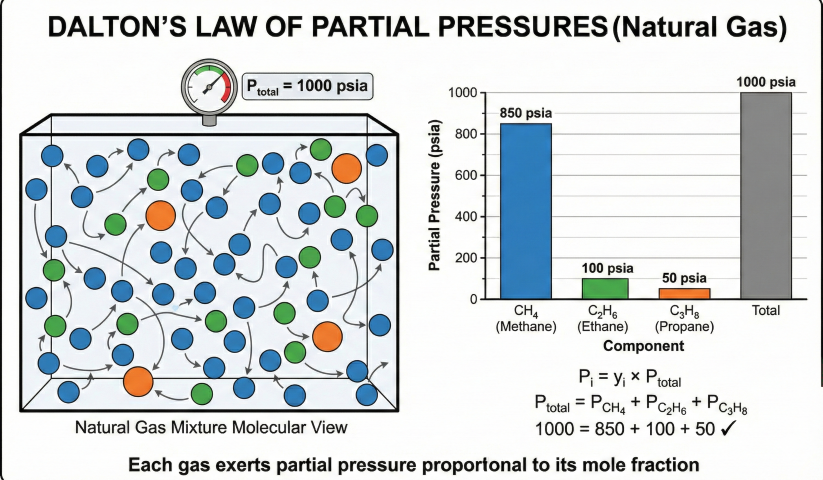
P_i = y_i × P_total
Where:
y_i = Mole fraction of component i (dimensionless)
y_i = n_i / n_total
Also:
P_i = n_i × R × T / V
Each component behaves as if it alone occupies the entire volume.
Relationship to Mole Fraction
Dalton's Law: each gas exerts partial pressure proportional to its mole fraction. P_total = P_CH4 + P_C2H6 + P_C3H8 = 850 + 100 + 50 = 1000 psia.
Mole Fraction and Partial Pressure:
y_i = n_i / n_total = P_i / P_total
Where:
y_i = Mole fraction of component i
n_i = Moles of component i
n_total = Total moles in mixture
Mole fractions sum to 1.0:
Σ y_i = y₁ + y₂ + y₃ + ... = 1.0
Partial pressures sum to total pressure:
Σ P_i = P_total
Example: Natural gas with 90% methane, 5% ethane, 5% propane at 500 psia
P_CH4 = 0.90 × 500 = 450 psia
P_C2H6 = 0.05 × 500 = 25 psia
P_C3H8 = 0.05 × 500 = 25 psia
Total = 450 + 25 + 25 = 500 psia ✓
Mixture Molecular Weight
Gas Mixture Molecular Weight:
MW_mixture = Σ (y_i × MW_i)
Where:
y_i = Mole fraction of component i
MW_i = Molecular weight of component i
Example: Natural gas mixture
- Methane (CH₄): 90 mol%, MW = 16.04
- Ethane (C₂H₆): 7 mol%, MW = 30.07
- Propane (C₃H₈): 3 mol%, MW = 44.10
MW_mix = 0.90×16.04 + 0.07×30.07 + 0.03×44.10
MW_mix = 14.44 + 2.10 + 1.32 = 17.86 lb/lbmol
This is used in all gas density and flow rate calculations.
Partial Pressure Applications
Application
Calculation
Example
Hydrocarbon dew point
P_i = y_i × P_total vs. vapor pressure
When P_propane > P_vapor, liquid forms
Water dew point
P_H2O = y_H2O × P_total
Determine hydrate formation conditions
Combustion calculations
P_O2 in air = 0.21 × P_total
Oxygen availability for burners
Amine treating
P_CO2 or P_H2S drive absorption
Design acid gas removal systems
Gas mixture density
ρ_mix = Σ(y_i × ρ_i)
Calculate mixture density at P/T
Vapor-Liquid Equilibrium
Dalton's law combines with Raoult's law for vapor-liquid equilibrium:
Raoult's Law (Ideal Solutions):
y_i × P_total = x_i × P_vapor,i
Where:
y_i = Mole fraction in vapor phase
x_i = Mole fraction in liquid phase
P_vapor,i = Pure component vapor pressure at system temperature
This determines when condensation occurs.
Example: Propane in natural gas at 100°F, 500 psia
P_vapor,propane at 100°F = 190 psia
If y_propane = 0.05 (5 mol%):
Partial pressure = 0.05 × 500 = 25 psia
Since 25 psia < 190 psia, propane stays in vapor phase ✓
If y_propane = 0.50 (50 mol%):
Partial pressure = 0.50 × 500 = 250 psia
Since 250 psia > 190 psia, propane condenses (forms liquid) ✗
Practical significance: Dalton's law allows analyzing gas mixtures component-by-component. Each component's partial pressure determines its phase behavior, chemical reactivity, and contribution to mixture properties. This is essential for dew point calculations, gas treating design, and combustion analysis. Always verify that mole fractions sum to 1.0 and partial pressures sum to total pressure.
5. Ideal vs. Real Gas
The ideal gas law is a useful approximation, but real gases deviate from ideal behavior due to molecular size and intermolecular forces. Knowing when ideal gas is accurate versus when real gas corrections are needed is critical for engineering calculations.
When Ideal Gas Law Applies
Ideal Gas Validity Criteria:
Ideal gas law is accurate (error < 1-2%) when:
1. Low pressure: P < 100 psia (7 bar)
2. High temperature: T > 2 × T_critical
3. Far from phase transition: P << P_vapor at given T
4. Low density: ρ < 0.5 lb/ft³ (8 kg/m³)
Why these conditions work:
- Low pressure → Large intermolecular distances → Negligible intermolecular forces
- High temperature → High kinetic energy → Molecules move independently
- Far from liquefaction → No attractive forces causing condensation
At standard conditions (14.7 psia, 60°F):
All gases behave nearly ideally (Z ≈ 0.998-1.002).
When Real Gas Corrections Required
Condition
Ideal Gas Error
Recommendation
P < 100 psia
< 1%
Ideal gas OK
100 < P < 500 psia
1-5%
Use Z-factor if accuracy matters
500 < P < 1500 psia
5-15%
Must use Z-factor or EOS
P > 1500 psia
> 15%
Rigorous EOS required (Peng-Robinson, AGA-8)
Near dew point
Highly variable
Phase equilibrium calculations essential
Real Gas Equation with Z-Factor
Real Gas Law:
PV = Z n R T
Where:
Z = Compressibility factor (dimensionless)
Z corrects for deviation from ideal behavior:
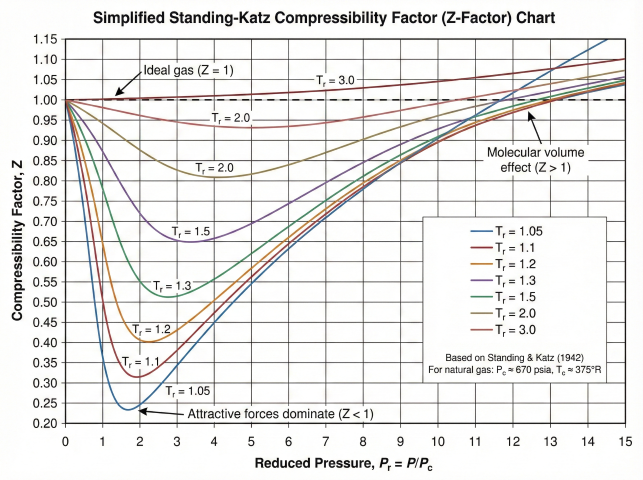
- Z = 1.0: Ideal gas
- Z < 1.0: Attractive forces dominate (gas more compressible than ideal)
- Z > 1.0: Repulsive forces dominate (gas less compressible than ideal)
For most pipeline gases at moderate pressure:
Z = 0.80–0.95
Real gas density:
ρ_real = ρ_ideal / Z
Since Z < 1 typically, real gas is denser than ideal prediction.
Van der Waals Equation
Simplest real gas equation accounting for molecular volume and attractive forces:
Van der Waals Equation (1873):
[P + a(n/V)²] × [V - nb] = nRT
Where:
a = Constant for intermolecular attraction (atm·L²/mol²)
b = Constant for molecular volume (L/mol)
Corrects ideal gas law:
- (n/V)² term: Pressure reduced by intermolecular attraction
- nb term: Volume reduced by molecular volume
For methane:
a = 2.303 atm·L²/mol²
b = 0.0431 L/mol
Van der Waals is qualitatively correct but quantitatively inaccurate.
Modern correlations (Peng-Robinson, Soave-Redlich-Kwong, AGA-8) much better.
Compressibility Factor Trends
Standing-Katz Z-factor chart (1942): Z dips below 1.0 at moderate pressures (attractive forces) and rises above 1.0 at very high pressures (molecular volume effect).
Pressure (psia)
Methane Z
Natural Gas Z (SG=0.6)
Interpretation
14.7
0.998
0.998
Nearly ideal
100
0.980
0.985
2% deviation
500
0.900
0.920
10% deviation
1000
0.830
0.870
15% deviation
2000
0.780
0.835
20% deviation
5000
0.950
1.020
Repulsion dominates (Z > 1)
Practical Decision Tree
Gas Law Selection Guide:
FOR SCREENING CALCULATIONS:
→ Use ideal gas law (PV = nRT)
→ Acceptable error: ±5-10%
FOR PIPELINE HYDRAULICS (P < 1500 psia):
→ Use Z-factor: PV = ZnRT
→ Calculate Z from Standing-Katz chart or correlation
→ Acceptable error: ±1-2%
FOR CUSTODY TRANSFER METERING:
→ Use AGA-8 Detail or GERG-2008 equation of state
→ Requires detailed composition (C1-C10+, N₂, CO₂, H₂S)
→ Acceptable error: ±0.1%
FOR PHASE EQUILIBRIUM (near dew point):
→ Use Peng-Robinson or Soave-Redlich-Kwong EOS
→ Requires composition and interaction parameters
→ Predict vapor-liquid equilibrium
FOR PROCESS SIMULATION:
→ Use commercial software (Aspen HYSYS, ProMax, UniSim)
→ Software selects appropriate EOS based on conditions
→ Validated against experimental data
Error Analysis Example
Problem: Compare ideal gas vs. real gas for 10 MMscfd at 1000 psia, 100°F
Given:
Q_std = 10 MMscfd (at 14.73 psia, 60°F)
P = 1000 psia, T = 100°F = 560°R
Natural gas: SG = 0.65, Z = 0.88 at these conditions
IDEAL GAS CALCULATION:
Q_actual = Q_std × (P_std/P) × (T/T_std)
Q_actual = 10 MMscfd × (14.73/1000) × (560/520)
Q_actual = 10 × 0.01473 × 1.077 = 0.159 MMacfd = 159 Macfd
REAL GAS CALCULATION:
Q_actual = Q_std × (P_std/P) × (T/T_std) × (Z/Z_std)
Q_actual = 10 MMscfd × (14.73/1000) × (560/520) × (0.88/1.0)
Q_actual = 10 × 0.01473 × 1.077 × 0.88 = 0.140 MMacfd = 140 Macfd
ERROR:
Ideal gas over-predicts by: (159-140)/140 = 13.6%
For orifice meter sizing, 13.6% error is unacceptable!
Must use real gas equation with Z-factor.
Common Misconceptions
"Natural gas is always an ideal gas": False. At pipeline pressures (500-1500 psia), Z = 0.80-0.90, causing 10-20% error if ignored.
"Z-factor only matters at very high pressure": False. Even at 500 psia, Z ≈ 0.92, causing 8% density error.
"Ideal gas is always conservative": Not necessarily. At very high pressure (P > 3000 psia), Z can exceed 1.0, making ideal gas underestimate density.
"Compressibility Z is a constant for a gas": False. Z varies with pressure and temperature for the same gas. Must recalculate for each condition.
"Ideal gas is OK for preliminary design": Depends. For equipment sizing where 10% error affects cost/performance, use real gas from the start.
Engineering judgment: For low-pressure applications (P < 100 psia), ideal gas law is sufficiently accurate and simplifies hand calculations. For pipeline systems (500-1500 psia), always use Z-factor corrections. For custody transfer and revenue metering, use rigorous methods (AGA-8). The cost of using the wrong equation (under/oversized equipment, inaccurate metering) far exceeds the effort of applying real gas corrections.
Final Comparison Example
Problem: Calculate density of methane at 1000 psia, 100°F using different methods
IDEAL GAS:
ρ = (P × MW) / (R × T)
ρ = (1000 × 16.04) / (10.73 × 560) = 16,040 / 6,009 = 2.67 lb/ft³
REAL GAS (Z = 0.88 from Standing-Katz):
ρ = (P × MW) / (Z × R × T)
ρ = (1000 × 16.04) / (0.88 × 10.73 × 560) = 16,040 / 5,288 = 3.03 lb/ft³
ERROR:
Ideal gas under-predicts density by: (3.03 - 2.67) / 3.03 = 11.9%
For mass flow measurement (ṁ = ρ × Q), 12% density error = 12% flow rate error.
At $3/Mscf and 10 MMscfd, this is $36,000/day revenue error ($13 million/year)!
Always use real gas corrections for revenue metering and custody transfer.