Convert between energy units (BTU, kWh, HP, kJ), calculate power requirements, fuel consumption rates, and analyze economic energy comparisons for pipeline and gas processing equipment.
Energy is the capacity to do work. In midstream operations, energy calculations are essential for equipment sizing, fuel consumption analysis, cost estimation, and efficiency optimization.
Compressor power
HP, kW calculations
Convert brake horsepower to kilowatts for motor selection and electrical sizing.
Fuel consumption
BTU/hr to scf/hr
Calculate gas consumption from heat input requirements for engines and heaters.
Heat duty
MMBtu/hr to kW
Size heat exchangers, heaters, and cooling systems using energy balance.
Economic analysis
Cost per unit energy
Compare operating costs for gas vs. electric vs. diesel equipment.
Fundamental Energy Units
Unit
Symbol
Definition
Typical Use
British Thermal Unit
BTU
Heat to raise 1 lb water by 1°F
US gas industry standard
Kilowatt-hour
kWh
1000 watts for 1 hour
Electrical energy billing
Horsepower
HP
550 ft-lb/s (mechanical power)
Compressor and pump sizing
Kilojoule
kJ
1000 joules (SI unit)
International standards
Therm
thm
100,000 BTU
Natural gas billing
Calorie
cal
Heat to raise 1 g water by 1°C
Laboratory, scientific
Energy vs. Power
Energy: Total quantity of work or heat (BTU, kWh, kJ) - cumulative over time
Power: Rate of energy transfer (BTU/hr, kW, HP) - instantaneous rate
Relationship: Energy = Power × Time (e.g., 1 kW × 1 hr = 1 kWh)
Example: A 100 HP compressor running 10 hours consumes 1000 HP-hr of energy
Why conversions matter: Equipment specifications mix units - compressor brake horsepower, electrical kW demand, gas fuel consumption in MMBtu/hr, and billing in therms or kWh. Accurate conversions ensure proper sizing, cost estimation, and fuel supply planning.
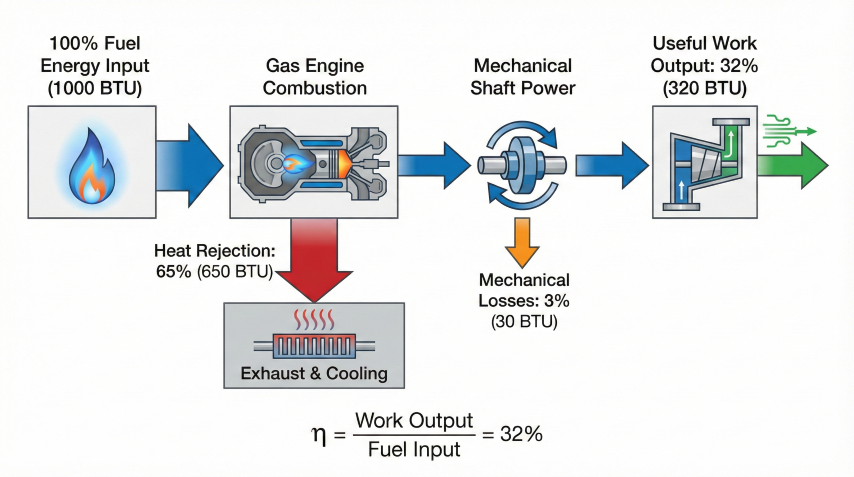
Energy flow from fuel input through combustion to useful work output, showing efficiency losses at each conversion stage.
2. Energy Unit Conversions
Energy unit conversions are essential for comparing equipment specifications, fuel options, and operating costs across different measurement systems.
Power Unit Conversions:
1 HP = 0.746 kW
1 HP = 2545 BTU/hr
1 HP = 0.707 Boiler HP
1 HP = 550 ft-lb/s
1 HP = 745.7 watts
1 kW = 1.341 HP
1 kW = 3412.14 BTU/hr
1 kW = 1000 joules/s
1 kW = 737.6 ft-lb/s
1 BTU/hr = 0.000393 HP
1 BTU/hr = 0.293 watts
1 BTU/hr = 0.0002931 kW
1 Boiler HP = 33,475 BTU/hr
1 Boiler HP = 9.81 kW
1 Boiler HP = 13.15 mechanical HP
Comprehensive Conversion Table
From/To
BTU
kWh
HP-hr
kJ
1 BTU
1.0
0.000293
0.000393
1.055
1 kWh
3412.14
1.0
1.341
3600
1 HP-hr
2545
0.746
1.0
2684.5
1 kJ
0.9478
0.000278
0.000373
1.0
1 MJ
947.8
0.278
0.373
1000
1 therm
100,000
29.3
39.3
105,506
Natural Gas Energy Content
Natural gas heating value varies with composition. Pipeline quality gas typically ranges from 950-1050 BTU/scf.
Gas Heating Values:
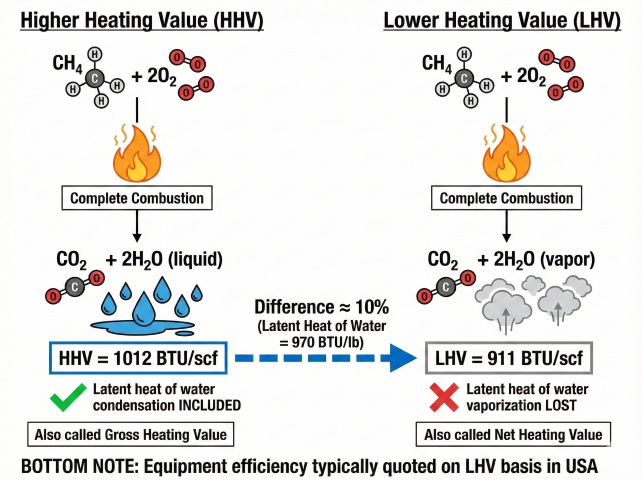
HHV (Higher Heating Value) - includes water condensation heat
LHV (Lower Heating Value) - excludes water condensation heat
Typical pipeline natural gas:
HHV = 1000-1050 BTU/scf (dry basis)
LHV = 900-950 BTU/scf (dry basis)
Relationship:
LHV ≈ HHV × 0.90 (for natural gas)
Standard conditions: 14.73 psia, 60°F
Conversion to other units:
1000 BTU/scf = 37.26 MJ/m³
1000 BTU/scf = 10.35 kWh/m³
Fuel Heating Values (EIA/GPSA Standards)
Fuel Type
HHV (BTU/unit)
LHV (BTU/unit)
Unit
Natural gas (pipeline)
1,000
900
scf
Methane (pure)
1,012
911
scf
Propane (gas)
2,516
2,316
scf
Propane (liquid)
91,500
84,250
gallon
Diesel fuel #2
137,380
128,700
gallon
Gasoline (regular)
120,286
109,000
gallon
Kerosene / Jet fuel
135,000
127,000
gallon
Crude oil (average)
5,800,000
5,400,000
barrel
Source: EIA Monthly Energy Review, GPSA. HHV includes latent heat of water vapor; LHV excludes it.
HHV vs LHV comparison showing the approximately 10% difference due to latent heat of water vaporization.
Example Calculation 1: HP to kW
Convert 1500 HP compressor brake horsepower to kilowatts for electrical motor sizing:
Given: Compressor requires 1500 brake HP
kW = HP × 0.746
kW = 1500 × 0.746
kW = 1119 kW
Add motor efficiency (assume 95%):
kW_input = 1119 / 0.95
kW_input = 1178 kW
Round up for motor selection: 1200 kW motor required
Example Calculation 2: Gas Energy to Volume
Calculate gas volume required for 10 MMBtu/hr heat duty:
Given:
Heat duty = 10 MMBtu/hr
Gas HHV = 1000 BTU/scf
Burner efficiency = 85%
Fuel input = Heat duty / Efficiency
Fuel input = 10,000,000 BTU/hr / 0.85
Fuel input = 11,765,000 BTU/hr
Gas flow = Fuel input / HHV
Gas flow = 11,765,000 / 1000
Gas flow = 11,765 scf/hr
Gas flow = 196 scfm
Convert to standard cubic meters:
11,765 scf/hr × 0.0283 m³/scf = 333 Sm³/hr
3. Power Calculations & Efficiency
Power calculations determine instantaneous energy transfer rates for equipment sizing, electrical demand, and fuel consumption rates.
Compressor Power
Adiabatic Compression Power:
BHP = (Q × P₁ × k / (k-1) × 229) × [(r^((k-1)/k) - 1)] / η
Where:
BHP = Brake horsepower (HP)
Q = Inlet flow rate (ACFM - actual cubic feet per minute)
P₁ = Inlet pressure (psia)
k = Specific heat ratio (Cp/Cv) ≈ 1.27 for natural gas
r = Compression ratio (P₂/P₁)
η = Compressor mechanical efficiency (0.80-0.85 typical)
229 = Conversion constant (33,000 ft-lb/min per HP ÷ 144 in²/ft²)
For multi-stage compression:
r_stage = r_overall^(1/n)
Where n = number of stages
Power per stage: BHP_stage = BHP_total / n
Pump Power
Liquid Pumping Power:
BHP = (Q × H × SG) / (3960 × η)
Where:
BHP = Brake horsepower (HP)
Q = Flow rate (GPM - gallons per minute)
H = Total head (feet)
SG = Specific gravity (relative to water)
η = Pump efficiency (0.70-0.85 typical)
3960 = Conversion constant
Total head:
H = H_static + H_friction + H_velocity + P_discharge/(2.31 × SG)
Alternatively in SI units:
kW = (Q × H × ρ × g) / (1000 × η)
Where:
Q = Flow rate (m³/s)
H = Total head (m)
ρ = Liquid density (kg/m³)
g = 9.81 m/s²
Heat Transfer Power
Heat Exchanger Duty:
Q = ṁ × Cp × ΔT
Where:
Q = Heat duty (BTU/hr or kW)
ṁ = Mass flow rate (lb/hr or kg/s)
Cp = Specific heat (BTU/lb·°F or kJ/kg·K)
ΔT = Temperature change (°F or K)
For phase change:
Q = ṁ × λ
Where λ = Latent heat (BTU/lb or kJ/kg)
Unit conversions:
1 MMBtu/hr = 293 kW
1 ton refrigeration = 12,000 BTU/hr = 3.517 kW
Electrical Power
Three-Phase Electrical Power:
kW = (√3 × V × I × PF) / 1000
Where:
kW = Real power (kilowatts)
V = Line voltage (volts)
I = Line current (amps)
PF = Power factor (0.80-0.95 typical)
√3 = 1.732
Apparent power:
kVA = (√3 × V × I) / 1000
Reactive power:
kVAR = kVA × sin(arccos(PF))
Relationship:
kVA² = kW² + kVAR²
Equipment Efficiency
Equipment Type
Typical Efficiency
Range
Notes
Electric motor (induction)
93%
90-96%
Higher for larger motors
Gas engine (4-stroke)
35%
30-40%
Shaft power / fuel energy
Gas turbine
32%
25-40%
Higher for combined cycle
Centrifugal compressor
80%
75-85%
Isentropic efficiency
Reciprocating compressor
83%
80-88%
Isentropic efficiency
Centrifugal pump
75%
70-85%
Hydraulic efficiency
Fired heater (gas)
85%
80-90%
Thermal efficiency
Shell-tube heat exchanger
92%
85-95%
Effectiveness
VFD (variable frequency drive)
97%
95-98%
Power electronics efficiency
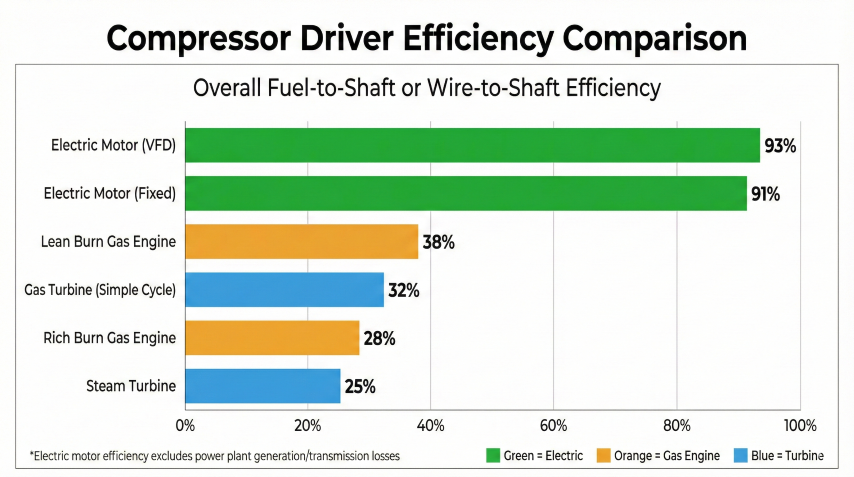
Efficiency cascade: A gas-engine-driven compressor has overall efficiency = engine efficiency × compressor efficiency = 0.35 × 0.80 = 0.28 (28%). This means 72% of fuel energy is rejected as heat. Electric motor driven: 0.93 × 0.80 = 0.74 (74% wire-to-air efficiency).
Compressor driver efficiency comparison showing overall fuel-to-shaft or wire-to-shaft efficiency for different driver types.
Example Calculation 3: Compressor Power
Calculate brake horsepower for a natural gas compressor:
Economic analysis compares operating costs for different fuel options, driver types, and energy sources to optimize facility design and operation.
Cost per Unit Energy
Normalized Energy Cost:
Cost_energy = Fuel_price / (Energy_content × Efficiency)
Where:
Cost_energy = Cost per useful energy ($/MMBtu delivered)
Fuel_price = Fuel cost in native units
Energy_content = HHV or energy value
Efficiency = Equipment efficiency
Examples:
Natural gas at $3.50/Mscf, 1020 BTU/scf, engine 32% efficiency:
Cost = $3.50 / (1.020 MMBtu/Mscf × 0.32)
Cost = $10.73 per MMBtu shaft work
Electricity at $0.10/kWh, motor 93% efficiency:
Cost = $0.10 / (0.003412 MMBtu/kWh × 0.93)
Cost = $31.52 per MMBtu shaft work
Diesel at $3.00/gal, 139,000 BTU/gal, engine 38% efficiency:
Cost = $3.00 / (0.139 MMBtu/gal × 0.38)
Cost = $56.80 per MMBtu shaft work
Annual Operating Cost
Annual Fuel Cost:
Cost_annual = Power × Hours × Fuel_rate × Fuel_price / (Energy_content × Efficiency)
Simplified:
Cost_annual = Load × Hours × Unit_cost
Where:
Load = Average power demand (HP, kW, MMBtu/hr)
Hours = Annual operating hours
Unit_cost = Fuel cost per unit energy delivered
For capacity factor:
Hours = 8760 hr/yr × CF
Where CF = capacity factor (0.0-1.0)
Breakeven Analysis
Electric vs. Gas Engine Breakeven:
Consider both capital and operating costs:
NPV = -Capital + Σ(Savings_annual / (1+r)^n)
Where:
NPV = Net present value
Capital = Additional capital cost
Savings_annual = Annual fuel cost difference
r = Discount rate
n = Year number
Simple payback (ignoring time value):
Payback = Capital_difference / Savings_annual
Example:
Electric motor: $200k capital, $150k/yr fuel
Gas engine: $150k capital, $80k/yr fuel
Capital difference: $200k - $150k = $50k higher for electric
Fuel savings: $150k - $80k = $70k/yr for electric
Payback = $50k / $70k = 0.7 years
In this case, gas engine has higher fuel cost,
so electric motor preferred if sufficient power available.
Fuel Cost Comparison Example
Driver Type
Fuel Price
Efficiency
Cost per HP-hr
Cost for 1500 HP × 8760 hr
Gas engine (rich burn)
$3.50/Mscf
28%
$0.0299
$393,066
Gas engine (lean burn)
$3.50/Mscf
32%
$0.0262
$344,058
Gas turbine
$3.50/Mscf
30%
$0.0279
$366,660
Diesel engine
$3.00/gal
38%
$0.0408
$536,112
Electric motor
$0.08/kWh
93%
$0.0643
$844,596
Electric motor
$0.05/kWh
93%
$0.0402
$527,873
Assumes: Gas HHV = 1020 BTU/scf, diesel = 139,000 BTU/gal, 1 HP-hr = 0.746 kWh, 1500 HP continuous load
Economic decision factors: Fuel cost comparison alone insufficient - must consider capital cost, maintenance, availability, emissions compliance, and reliability. Remote locations favor gas engines (no electrical infrastructure). Urban areas may require electric motors (emissions). Gas turbines preferred for >5000 HP due to lower capital cost per HP.
📊 Image: Fuel Cost per HP-hr Comparison
Bar chart showing operating cost comparison: Gas engine $0.026/HP-hr, Electric motor at $0.05/kWh $0.04/HP-hr, Diesel $0.041/HP-hr
Example Calculation 5: Gas vs. Electric Economics
Compare 20-year lifecycle costs for 2000 HP compressor station:
Option 1: Gas engine driven
Capital cost: $1,500,000 (installed)
Fuel: $3.50/Mscf, consumption 16.4 MMscfd @ 28% efficiency
Maintenance: $0.015/HP-hr = $262,800/yr
Capacity factor: 0.85 (7446 hr/yr)
Overhaul: $300,000 every 5 years
Option 2: Electric motor driven
Capital cost: $2,200,000 (with electrical substation)
Electricity: $0.07/kWh
Motor efficiency: 94%
Maintenance: $0.005/HP-hr = $74,460/yr
Capacity factor: 0.85 (7446 hr/yr)
Gas engine annual costs:
Fuel: 16.4 Mscf/day × 365 days × $3.50/Mscf × 0.85 CF = $18,250/yr
Maintenance: $262,800/yr
Overhaul (annualized): $300,000 / 5 = $60,000/yr
Annual O&M: $341,050/yr
Electric motor annual costs:
Power: 2000 HP × 0.746 kW/HP / 0.94 × 7446 hr × $0.07/kWh
Power: 1492 kW × 7446 hr × $0.07 = $776,460/yr
Maintenance: $74,460/yr
Annual O&M: $850,920/yr
20-year NPV at 8% discount rate:
Gas: -$1,500k - $341k × 9.818 = -$4,849k
Electric: -$2,200k - $851k × 9.818 = -$10,555k
Gas engine wins by $5,706k NPV over 20 years
Breakeven electricity price:
Gas annual cost = $341k
Required electric annual = $341k
$341k = kW × 7446 hr × $/kWh + $74.5k
$266.5k = 1492 kW × 7446 hr × $/kWh
$/kWh = $0.024
At electricity prices below $0.024/kWh, electric motor preferred
At current $0.07/kWh, gas engine strongly preferred
Sensitivity Factors
Gas price volatility: Natural gas prices vary seasonally and regionally ($2-6/Mscf typical range)
Electricity demand charges: Commercial rates include demand charges ($10-20/kW-month) that increase costs