Drip pots (drips, condensate traps) collect liquids that condense from gas streams in pipelines. Periodic blowdown removes accumulated liquids to prevent operational problems.
Why Drips Are Needed
Liquid slugging
Equipment Protection
Prevents compressor damage and meter errors from liquid carry-through.
Hydrate prevention
Flow Assurance
Reduces hydrate formation risk at low temperatures.
Corrosion control
Integrity
Eliminates water pooling that causes internal corrosion.
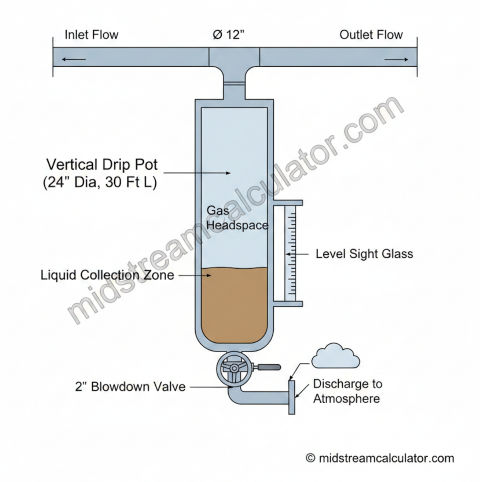
Vertical drip pot system schematic showing key components for condensate collection and blowdown.
Common Drip Locations
Location
Purpose
Typical Size
Pipeline low points
Collect condensate from grade changes
10-30 bbl
Compressor suction
Protect compressor from liquid slugs
20-50 bbl
Meter station inlet
Ensure dry gas for accurate metering
10-20 bbl
Regulator upstream
Prevent liquid carryover through valve
10-30 bbl
Key principle: Drip pots must be sized for the maximum expected liquid accumulation between blowdowns, plus a safety margin for upset conditions.
2. Drip Pot Sizing
Drip sizing is based on condensate rate, desired blowdown frequency, and a safety factor for upsets.
Sizing Formula
Required Drip Volume:
V_drip = Q_condensate × t_blowdown × SF
Where:
V_drip = Drip pot volume (bbl)
Q_condensate = Condensate accumulation rate (bbl/day)
t_blowdown = Days between blowdowns
SF = Safety factor (1.5-2.0 typical)
Example:
Condensate rate: 2 bbl/day
Blowdown frequency: Weekly (7 days)
Safety factor: 1.5
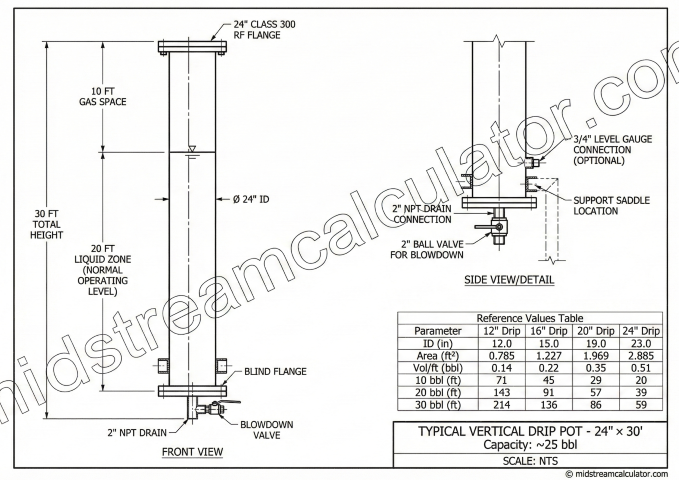
V_drip = 2 × 7 × 1.5 = 21 bbl → Use 24" × 30 ft (≈25 bbl)
Vertical Drip Dimensions
Pipe Diameter
Volume per ft
10 bbl Length
20 bbl Length
12"
0.14 bbl/ft
71 ft
143 ft
16"
0.25 bbl/ft
40 ft
80 ft
20"
0.39 bbl/ft
26 ft
52 ft
24"
0.56 bbl/ft
18 ft
36 ft
Typical vertical drip pot dimensions (24" × 30') with reference values table for various pipe sizes.
Condensate Sources
Retrograde condensation: Pressure drop through regulators causes temperature drop (JT cooling) and liquid dropout
Water condensation: Cooling below water dewpoint as gas travels through buried pipeline
Carryover: Liquid entrainment from upstream separators during slug events
Design tip: Oversize drips by 50-100%. They are inexpensive and provide flexibility for extended blowdown intervals during bad weather or higher-than-expected condensate rates.
3. Gas Loss Calculation
Gas is vented during blowdown operations. Accurate loss estimation is required for emissions reporting (EPA Subpart W) and production accounting.
Engineering Method
Gas Volume from Real Gas Law:
Q_scf = (P × V) / (Z × T) × (T_std / P_std)
Where:
P = Operating pressure (psia)
V = Drip pot gas volume (ft³)
Z = Compressibility factor (from Hall-Yarborough or similar)
T = Operating temperature (°R)
T_std = 519.67°R (60°F standard)
P_std = 14.696 psia
Example:
Operating: 500 psig (514.7 psia), 60°F (519.67°R)
Drip volume: 10 bbl = 56.15 ft³
Gas SG: 0.65, Z ≈ 0.88
Q_scf = (514.7 × 56.15) / (0.88 × 519.67) × (519.67 / 14.696)
Q_scf = 63.22 × 35.36 = 2,236 scf = 2.24 MCF per blowdown
Field Estimation Method
When detailed operating data isn't available, use emission factors based on blow counts:
Component
Base Factor
Basis
Wet blow
1.0 MCF/blow
Gas displaced by liquid during initial blows (500 psig reference)
Dry blow
5.0 MCF/blow
Gas vented after liquid cleared (higher volume per blow)
Dissolved gas
1.05 scf/gal
Gas released from condensate at 100 psig (scales with P^0.5)
Pressure Adjustment
Pressure Scaling for Field Factors:
Emission Factor = Base Factor × (P_actual + 14.7) / (P_reference + 14.7)
Example at 800 psig:
Wet blow factor = 1.0 × (814.7 / 514.7) = 1.58 MCF/blow
Dry blow factor = 5.0 × (814.7 / 514.7) = 7.92 MCF/blow
Higher pressure = more gas per blowdown = higher emissions
Reporting note: Per EPA 40 CFR 98 Subpart W, blowdown emissions from pipeline drips must be reported if facility exceeds 25,000 mt CO₂e/year threshold.
4. Blowdown Procedures
Safe blowdown procedures protect personnel and minimize environmental impact.
Pre-Blowdown Checklist
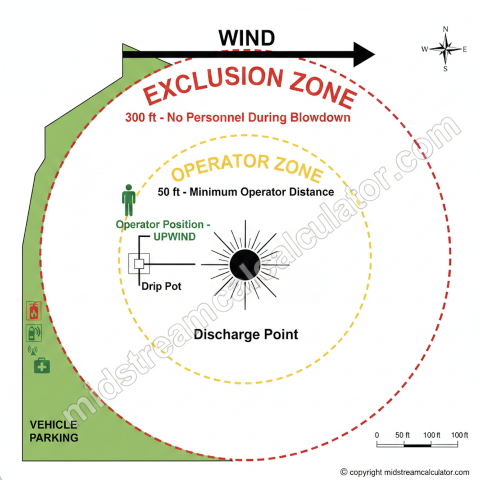
Area clear: No personnel within 300 ft of discharge point
Wind check: Discharge direction favorable (downwind from operator)
Ignition sources: No vehicles, equipment, or smoking nearby
Valve inspection: Exercise blowdown valve to verify operation
Manual Blowdown Procedure:
1. Position 50+ ft from discharge, upwind
2. Slowly crack valve open (1/4 turn)
- Initial discharge is high-pressure gas
- Listen for pressure equalization
3. Gradually open as pressure decreases
- Watch for liquid discharge (sound/appearance changes)
4. Full open when liquid appears
- Continue until steady gas flow (no slugs)
- Duration: typically 2-5 minutes
5. Close slowly when clear gas observed
- Avoid water hammer from rapid closure
6. Record: date, time, estimated volume, observations
Blowdown Frequency Guidelines
Condensate Rate
Frequency
< 0.5 bbl/day
Monthly
0.5-2 bbl/day
Weekly
2-5 bbl/day
Every 2-3 days
> 5 bbl/day
Daily or automatic
Minimize dry blows: Dry blows contribute 5× more gas loss than wet blows. Blow until liquid stops, then close promptly. Excessive "clearing" wastes gas.
5. Safety & Compliance
Primary Hazards
Hazard
Control
High-pressure gas release
Stand clear, use extended handles, hearing protection
Flammable atmosphere
Clear ignition sources, verify wind direction
H₂S (sour gas)
Personal monitors, buddy system, SCBA available, upwind position
Liquid hydrocarbon contact
FRC, chemical gloves, eye protection
JT freezing
Insulated gloves, slow valve opening
H₂S Considerations
For sour gas service (H₂S > 100 ppm in gas):
Two-person minimum (buddy system)
Personal H₂S monitors with audible alarms
SCBA equipment available on-site
Wind indicator visible (sock or ribbon)
Increase exclusion zone to 500+ ft
Consider closed-loop blowdown to recovery tank
Environmental Compliance
EPA Subpart W Requirements:
Facilities must report blowdown emissions if:
- Total facility emissions exceed 25,000 mt CO₂e/year
- Blowdowns counted toward Source Category W.5 (pipeline venting)
Recommended practices:
- Document all blowdown events (date, time, volume, duration)
- Track annual totals by drip location
- Consider vapor recovery for high-volume operations
- Implement automatic drips to minimize per-event losses
Blowdown safety zones: 300 ft exclusion, 50 ft minimum operator distance, position upwind of discharge.
Complacency kills: Drip blowdown is routine but hazardous. Three leading causes of incidents: (1) failure to check wind direction → H₂S exposure, (2) ignition source not cleared → fire, (3) valve failure from poor maintenance → uncontrolled release.