1. Overview & Objectives
Condensate stabilization removes light hydrocarbons (C1-C3) from natural gas condensate to reduce vapor pressure for safe storage and transport.
RVP Control
Reduce from 20-40 psi to 10-12 psi specification
NGL Recovery
Recover C2-C3 as saleable products
Safety
Prevent tank overpressure and VOC emissions
Compliance
Meet pipeline tariff requirements
Why Stabilization is Required
- Unstabilized condensate contains dissolved light ends that flash at atmospheric pressure
- Tank safety: High RVP can overpressurize atmospheric tanks (API 650 limit ~1 oz/in²)
- Transport losses: Volatile condensate loses 5-15% volume in transit
- Environmental: VOC emissions violate air quality regulations
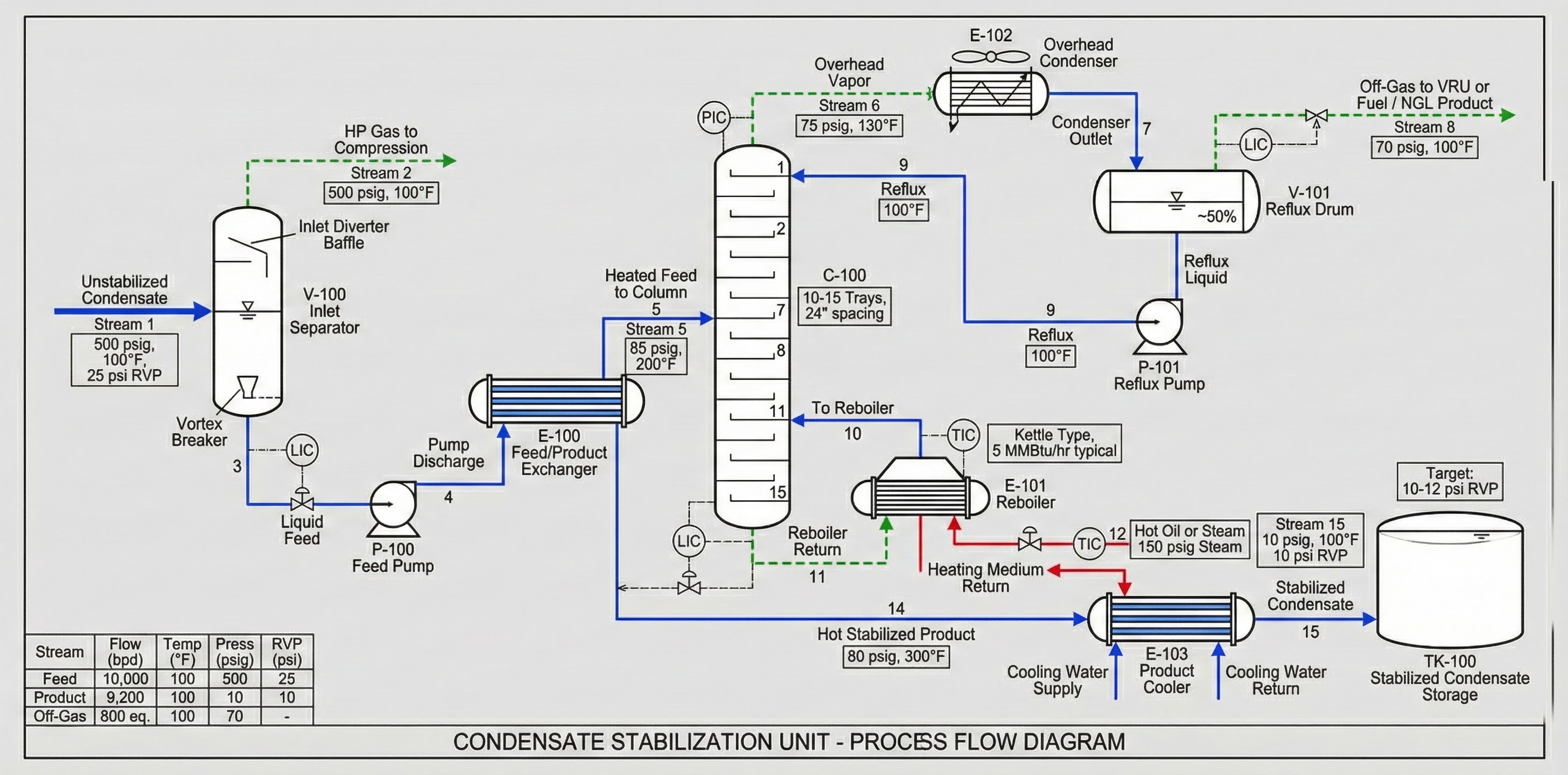
Typical Compositions
| Component | Unstabilized | Stabilized | Notes |
|---|---|---|---|
| Methane (C1) | 5-15% | <0.5% | Removed |
| Ethane (C2) | 8-15% | 1-3% | Mostly removed |
| Propane (C3) | 10-20% | 3-8% | Partially removed |
| Butanes (C4) | 8-12% | 10-15% | Retained |
| C5+ | 40-60% | 75-85% | Concentrated |
Economic trade-off: Lower RVP = more light ends removed = higher NGL value but 5-15% liquid shrinkage. Optimize based on product prices and energy costs.
2. Vapor Pressure & RVP
Reid Vapor Pressure (RVP) per ASTM D323 is measured at 100°F with 4:1 vapor-to-liquid ratio.
RVP Specifications
Pipeline condensate: 10-12 psi
Truck transport: 11-14 psi
Atmospheric storage: 7-10 psi
Crude oil: 10-15 psi
Note: RVP reported as gauge pressure
Raoult's Law
Bubble Point Pressure
P_bubble = Σ(x_i × P_i^sat)
Where:
x_i = Mole fraction in liquid
P_i^sat = Pure component vapor pressure at T
Component Vapor Pressures at 100°F
| Component | NBP (°F) | VP @ 100°F (psia) | Tc (°F) | Pc (psia) |
|---|---|---|---|---|
| Methane | -259 | Supercritical | -117 | 668 |
| Ethane | -128 | 660 | 90 | 708 |
| Propane | -44 | 190 | 206 | 617 |
| i-Butane | 11 | 80 | 275 | 529 |
| n-Butane | 31 | 52 | 306 | 551 |
| n-Pentane | 97 | 15.6 | 385 | 489 |
| n-Hexane | 156 | 4.4 | 454 | 437 |
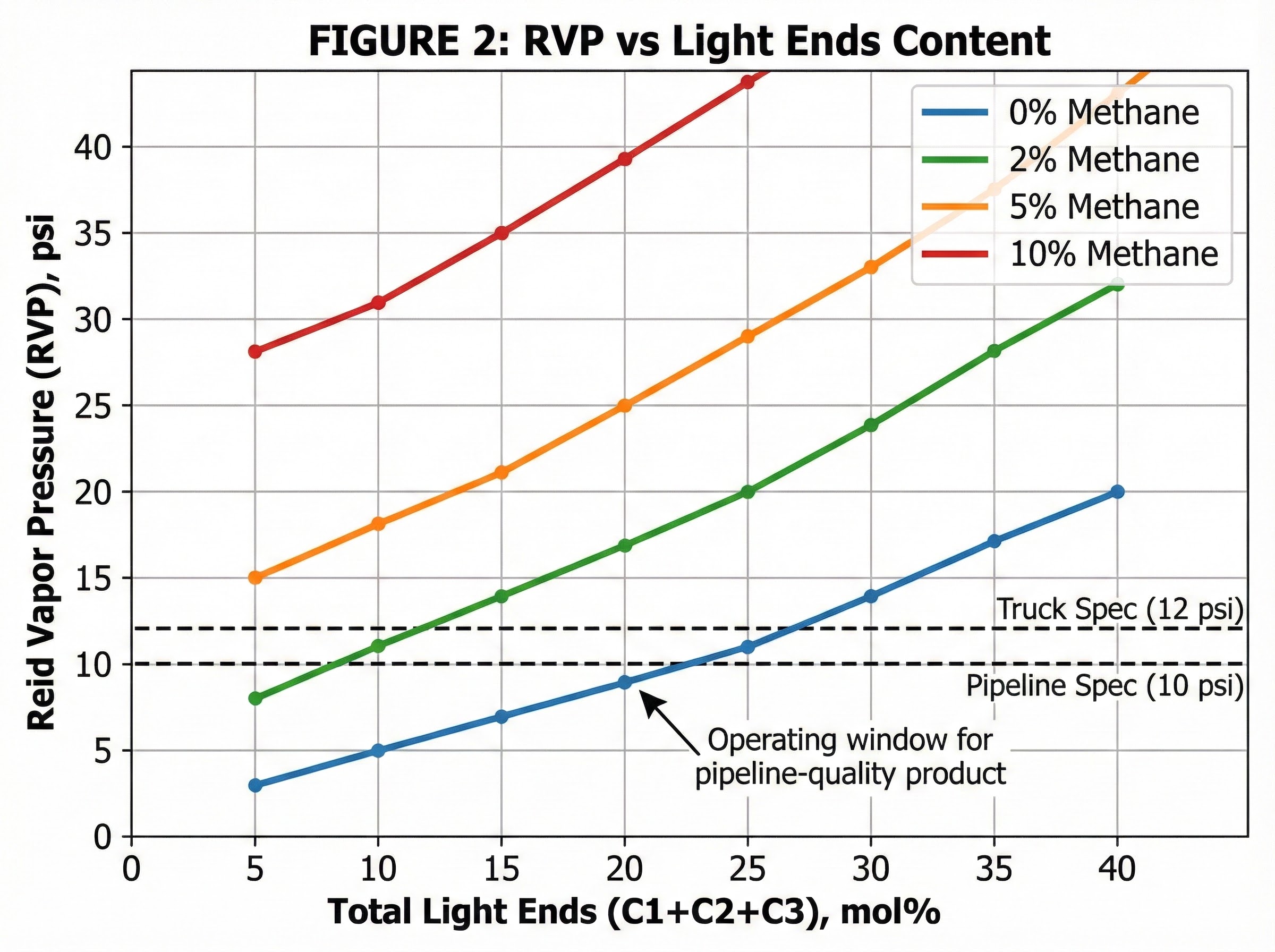
For 10 psi RVP: Remove all C1 (<0.5%), reduce C2 to 1-3%, adjust C3 to 5-10%, retain C4+.
3. Flash Calculations
Flash calculations determine vapor-liquid equilibrium at specified T and P.
Isothermal Flash (Rachford-Rice)
Given: Feed z_i, Temperature T, Pressure P
Find: Vapor fraction V, compositions x_i, y_i
Equilibrium: y_i = K_i × x_i
Material balance:
x_i = z_i / [1 + V(K_i - 1)]
y_i = K_i × z_i / [1 + V(K_i - 1)]
Solve: Σ[z_i(K_i-1)/(1+V(K_i-1))] = 0
K-Value Estimation
Wilson Correlation
K_i = (Pc_i/P) × exp[5.37(1+ω_i)(1-Tc_i/T)]
Typical K at 100°F, 100 psia:
C1: ~40 (volatile)
C2: ~6
C3: ~1.8
nC4: ~0.7
nC5: ~0.25 (stays liquid)
For design: Use Peng-Robinson or SRK EOS
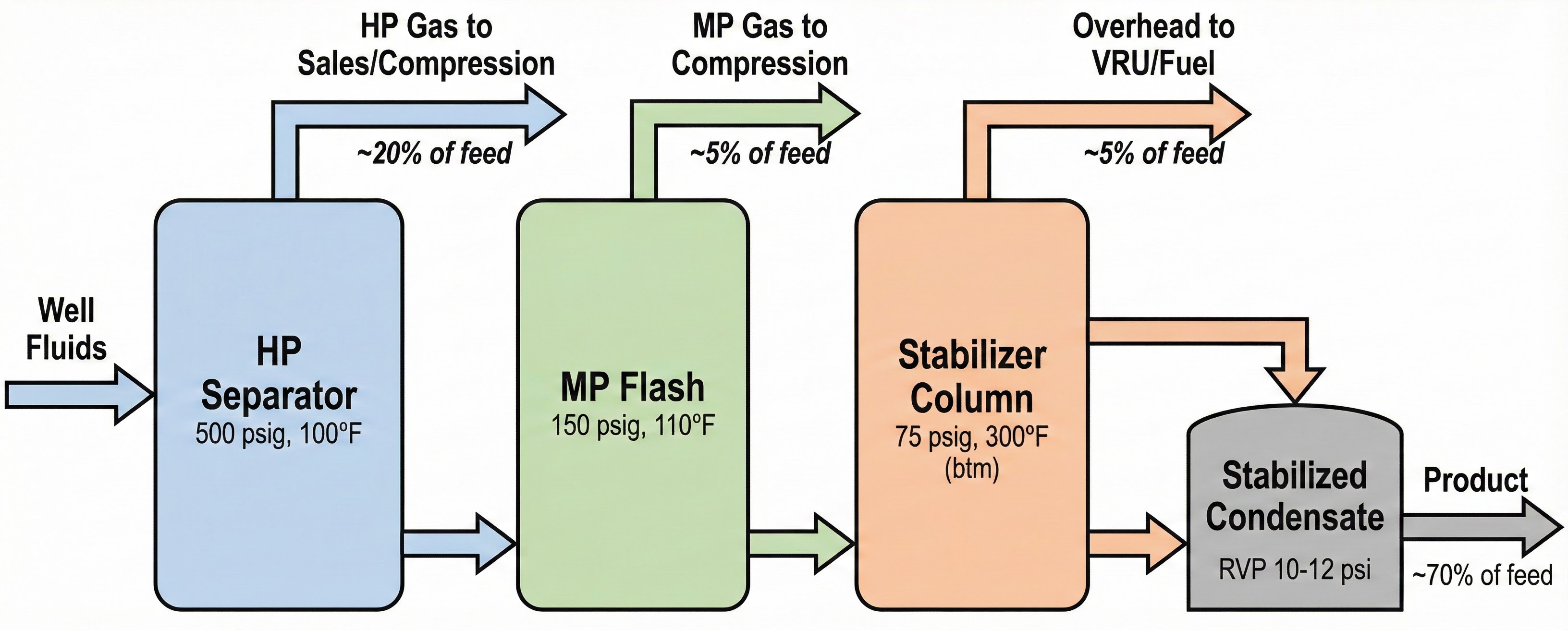
Separation Methods Comparison
| Method | Stages | RVP Achievable | Application |
|---|---|---|---|
| Single flash | 1 | 15-20+ psi | Rough separation |
| Multi-stage flash | 2-4 | 12-15 psi | <3,000 bpd |
| Stabilizer column | 8-15 | 8-12 psi | >3,000 bpd |
4. Stabilizer Column Design
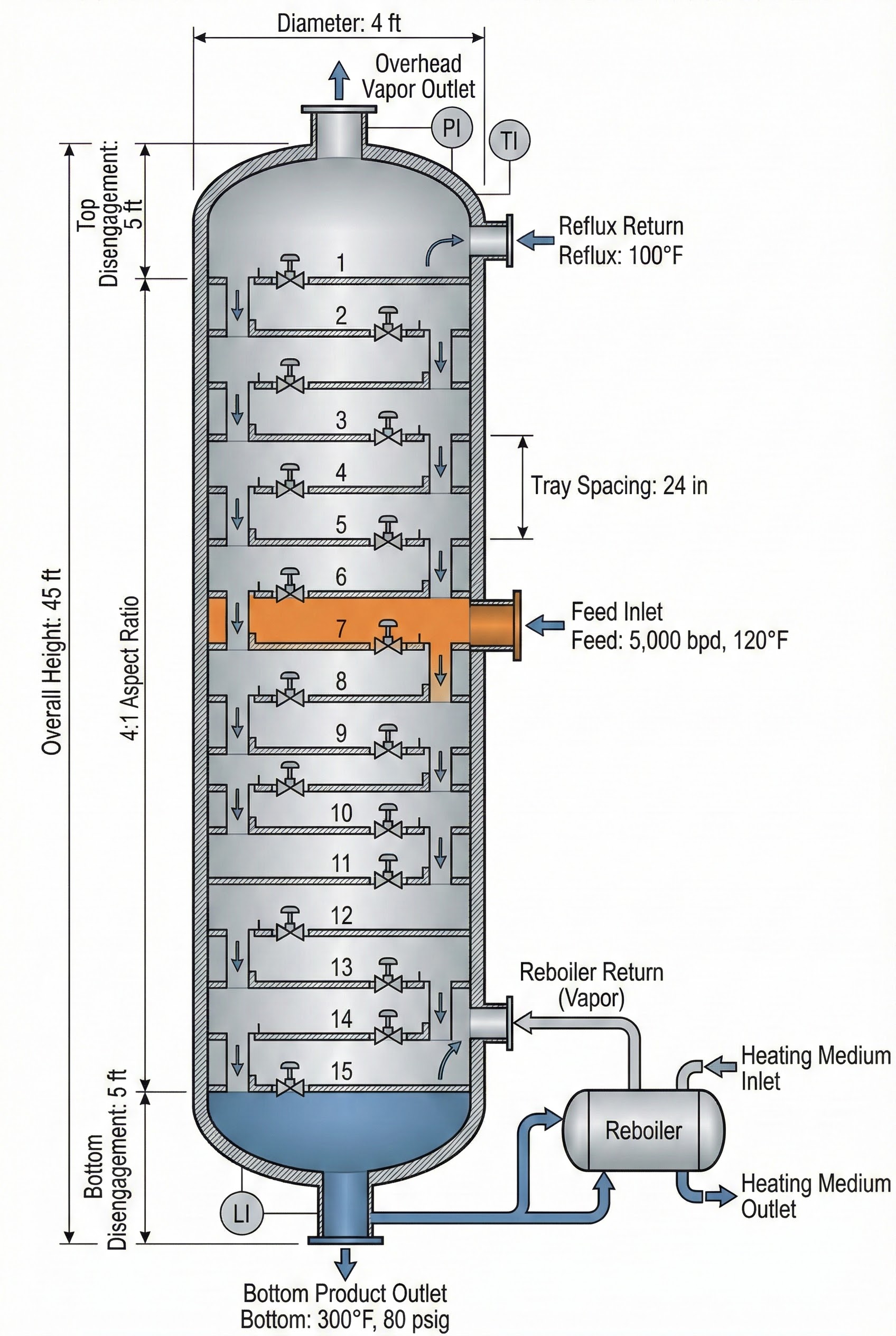
A stabilizer is a fractionation tower using heat (reboiler) and trays/packing to strip light ends.
Typical Configuration
Feed: Unstabilized at 20-40 psi RVP
Feed location: Middle (tray 4-6 of 10-15)
Column pressure: 50-100 psig
Bottom temp: 250-350°F
Overhead temp: 100-150°F
Trays: 10-18 actual
Reflux ratio: 0.5-2.0
Reboiler Duty
Heat Balance
Q_reboiler = Q_latent + Q_sensible + Q_reflux + Q_losses
Q_latent = m_vapor × λ_avg
Where λ_avg ≈ 150 BTU/lb for C2-C4 mixture
Q_sensible = m_feed × Cp × ΔT
Where Cp ≈ 0.5 BTU/lb-°F
Example (10,000 bpd, medium condensate):
Vapor rate: 10% of feed ≈ 29,000 lb/hr
Q_latent = 29,000 × 150 = 4.35 MMBtu/hr
Q_total ≈ 5-6 MMBtu/hr with margins
Column Sizing
Diameter (Souders-Brown)
V_flood = C × √[(ρL - ρV)/ρV]
Where C ≈ 0.35 for valve trays
V_design = 0.80 × V_flood
D = √(4 × Q_v / (π × V_design))
Height
N_actual = N_theoretical / E_tray
Where E_tray ≈ 0.5-0.7
Height = N × Spacing + Disengagement
Typical: 30-50 ft total
Reflux Ratio Effects
| L/D | Separation | Reboiler Duty | Notes |
|---|---|---|---|
| 0 | Poor | Low | Cannot meet spec |
| 0.5-1.0 | Adequate | Moderate | Typical operation |
| 1.5-2.0 | Sharp | Higher | Better C3 recovery |
| >3 | Excellent | Very high | Diminishing returns |
Design verification: Use commercial simulators (HYSYS, ProMax, UniSim) for rigorous design. Hand calculations provide estimates only.
5. Operations & Control
RVP Control Strategy
Primary Control: Reboiler Temperature
↑ Reboiler temp → More C3 stripped → Lower RVP
↓ Reboiler temp → Retain more C3 → Higher RVP
Secondary Controls:
• Column pressure: Lower P → easier stripping
• Reflux rate: Higher → sharper separation
• Feed rate: Capacity limited
Typical Scheme:
• TC on reboiler outlet (250-350°F SP)
• PC on overhead (vents to compressor/flare)
• LC on reflux drum and column bottom
• Lab RVP daily; adjust reboiler temp
Common Problems
| Problem | Cause | Solution |
|---|---|---|
| High RVP | Low reboiler heat | Increase temp, reduce feed |
| Low RVP (over-strip) | Excess heat | Reduce temp |
| Flooding | High vapor velocity | Reduce feed, check trays |
| Weeping | Low vapor rate | Increase reboiler duty |
| Foaming | Contaminants | Add antifoam, clean feed |
Yield Calculations
Liquid Yield
Yield = (Stabilized bpd) / (Unstabilized bpd) × 100%
Typical: 85-95%
Example:
Feed: 10,000 bpd
Overhead: 8% (800 bpd equivalent)
Product: 9,200 bpd
Yield: 92%
Economics:
Unstabilized: 10,000 × $50 = $500,000/day
Stabilized: 9,200 × $55 = $506,000/day
NGL value: 800 × $30 = $24,000/day
Total: $530,000/day (+6%)
Safety Considerations
- PSV sizing: Fire case or reboiler runaway per API 521
- High temp alarm: Prevent coking (>375°F)
- Vapor control: Route overhead to flare or VRU
- H2S: Concentrates in overhead; handle as sour gas if present
Best practice: Establish baseline reboiler temperature for typical feed. Trend RVP vs. operating conditions to identify composition changes or fouling.
Ready to use the calculator?
→ Launch Calculator