Atmospheric pressure is the force exerted by the weight of air above a given point. It decreases with altitude and varies with weather. All gas law calculations require absolute pressure—using gauge pressure is a common and costly error.
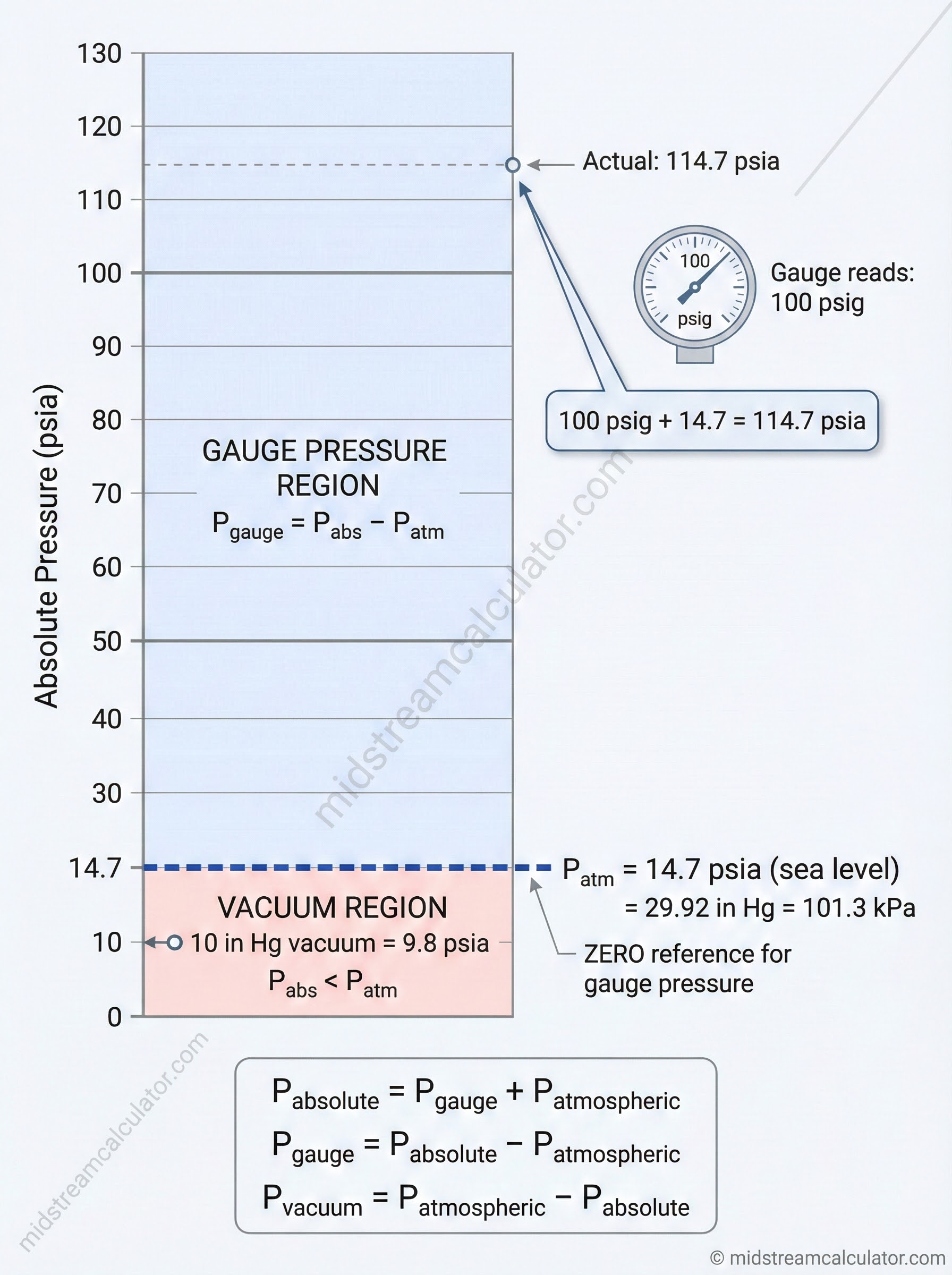
Pressure reference scale showing relationship between absolute, gauge, and vacuum pressure.
Absolute Pressure
Pabs (psia)
Referenced to perfect vacuum. Required for gas laws.
Gauge Pressure
Pgauge (psig)
Referenced to local atmosphere. What field gauges read.
Vacuum
Pvac (in Hg)
Pressure below atmospheric. Pabs = Patm − Pvac
Barometric
Patm (psia)
Local atmospheric pressure. Varies with elevation and weather.
⚠️ Critical: Gas laws (PV = nRT), density, and compressibility calculations require absolute pressure. Using gauge pressure causes 10–15% errors at typical conditions.
2. Standard Conditions
Different industries use different "standard" base conditions. The difference matters for custody transfer—verify contract specifications.
Standard
Pressure
Temperature
Use
AGA / API 14.3
14.73 psia
60°F
US natural gas custody transfer
API (Liquids)
14.696 psia
60°F
Oil, NGL measurement
ISO 13443
101.325 kPa
15°C
International gas/LNG
ISA / ICAO
14.696 psia
59°F
Atmospheric modeling
EPA
14.7 psia
68°F
Emissions reporting
Volume Correction
Flow at Standard Conditions:
Qstd = Qactual × (Pactual / Pbase) × (Tbase / Tactual) × (Zbase / Zactual)
T in absolute units (°R = °F + 459.67). Zbase ≈ 1.0 at standard conditions.
💰 Contract Impact: 14.696 vs. 14.73 psia = 0.23% difference. On 100 MMscfd, that's 230 Mscfd or ~$420,000/year at $5/MMBtu.
3. Altitude Corrections
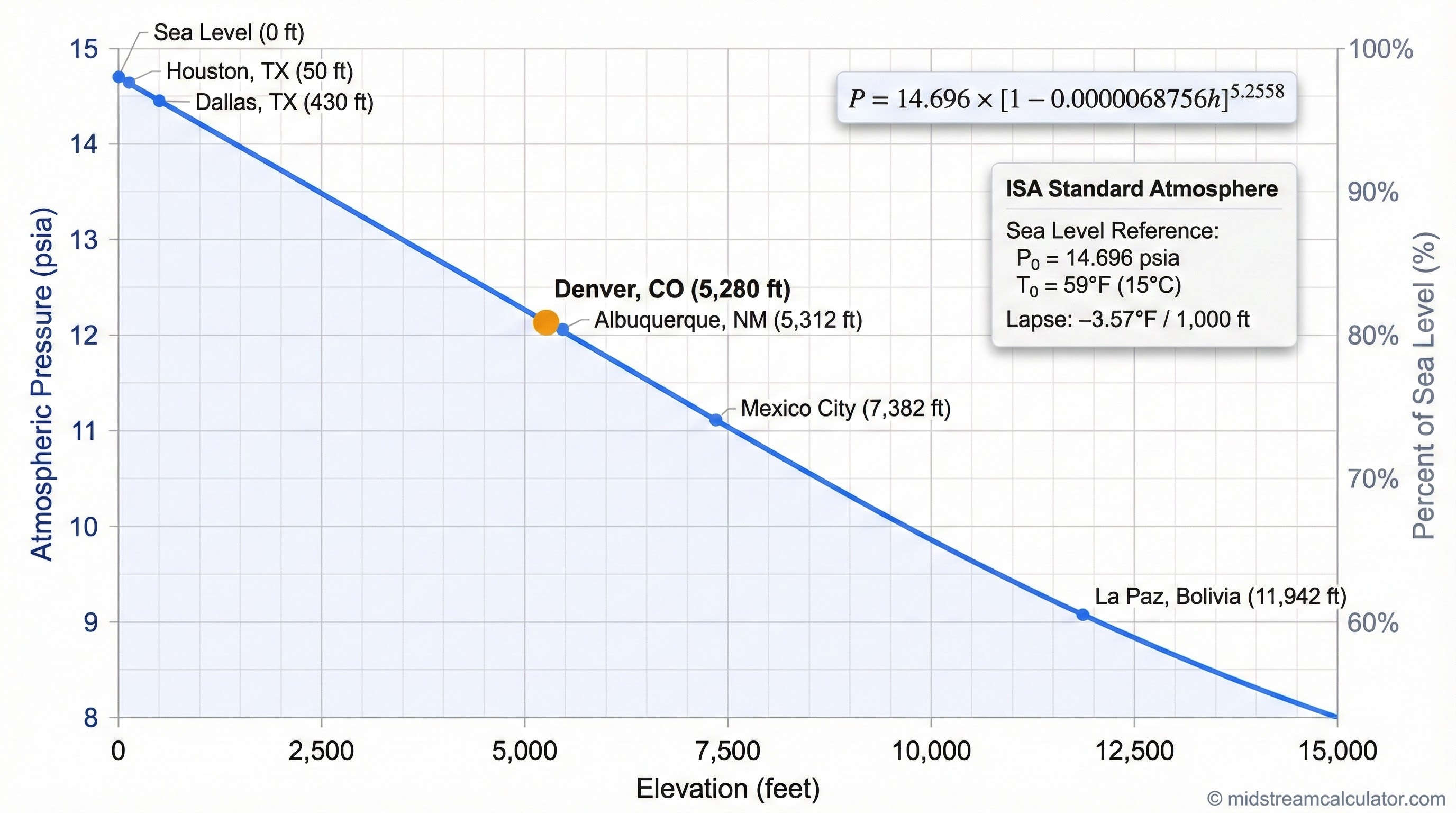
Atmospheric pressure decreases with elevation. Use actual Patm for gauge-to-absolute conversions at elevated sites.
Atmospheric pressure vs. elevation per ISA barometric formula.
ISA Barometric Formula
ICAO Standard Atmosphere (valid to 36,089 ft):
P = 14.696 × [1 − (0.0000068756 × h)]5.2558h = elevation in feet. Reference: ICAO Doc 7488, US Std Atmosphere 1976Quick Approximation (±2% to 10,000 ft):
Patm ≈ 14.7 − (h ÷ 2,000)
Denver (5,280 ft): P ≈ 14.7 − 2.64 = 12.06 psia (actual: 12.10)
Reference Table
Elevation
Patm (psia)
in Hg
% Sea Level
Sea level
14.696
29.92
100%
1,000 ft
14.17
28.86
96%
2,500 ft
13.41
27.31
91%
5,280 ft (Denver)
12.10
24.63
82%
7,500 ft
11.10
22.60
76%
10,000 ft
10.11
20.58
69%
Weather Variation
Sea Level Barometric Range:
High pressure: 30.2–30.9 in Hg (14.9–15.2 psia)
Normal: 29.5–30.2 in Hg (14.5–14.9 psia)
Low pressure: 28.5–29.5 in Hg (14.0–14.5 psia)
Hurricane: < 27.9 in Hg (< 13.7 psia)
⚠️ Weather Station Caution: Reported "barometric pressure" is often corrected to sea level for comparison. At Denver, weather may report 30.0 in Hg when actual station pressure is only 24.6 in Hg. Verify before using.
4. Unit Conversions
Common Conversions
From
To
Multiply By
psi
kPa
6.89476
psi
bar
0.06895
bar
psi
14.504
psi
in Hg
2.036
in Hg
psi
0.4912
psi
in H₂O
27.68
ft H₂O
psi
0.4331
atm
psi
14.696
Standard Atmosphere Equivalents
1 atm (exactly) =
14.696 psia = 101.325 kPa = 1.01325 bar
29.92 in Hg = 760 mm Hg = 760 Torr
33.9 ft H₂O = 407 in H₂O = 1013.25 mbar
Gauge ↔ Absolute
Ppsia = Ppsig + Patm
Pbara = Pbarg + 1.01325 × (Patm/14.696)
PkPa abs = PkPag + 101.325 × (Patm/14.696)
Use local Patm for elevated sites, not sea level value.
📋 International Note: "2 bar" is ambiguous—could be gauge or absolute. Use barg (gauge) or bara (absolute). Similarly: psig/psia, kPag/kPa abs.
5. Engineering Applications
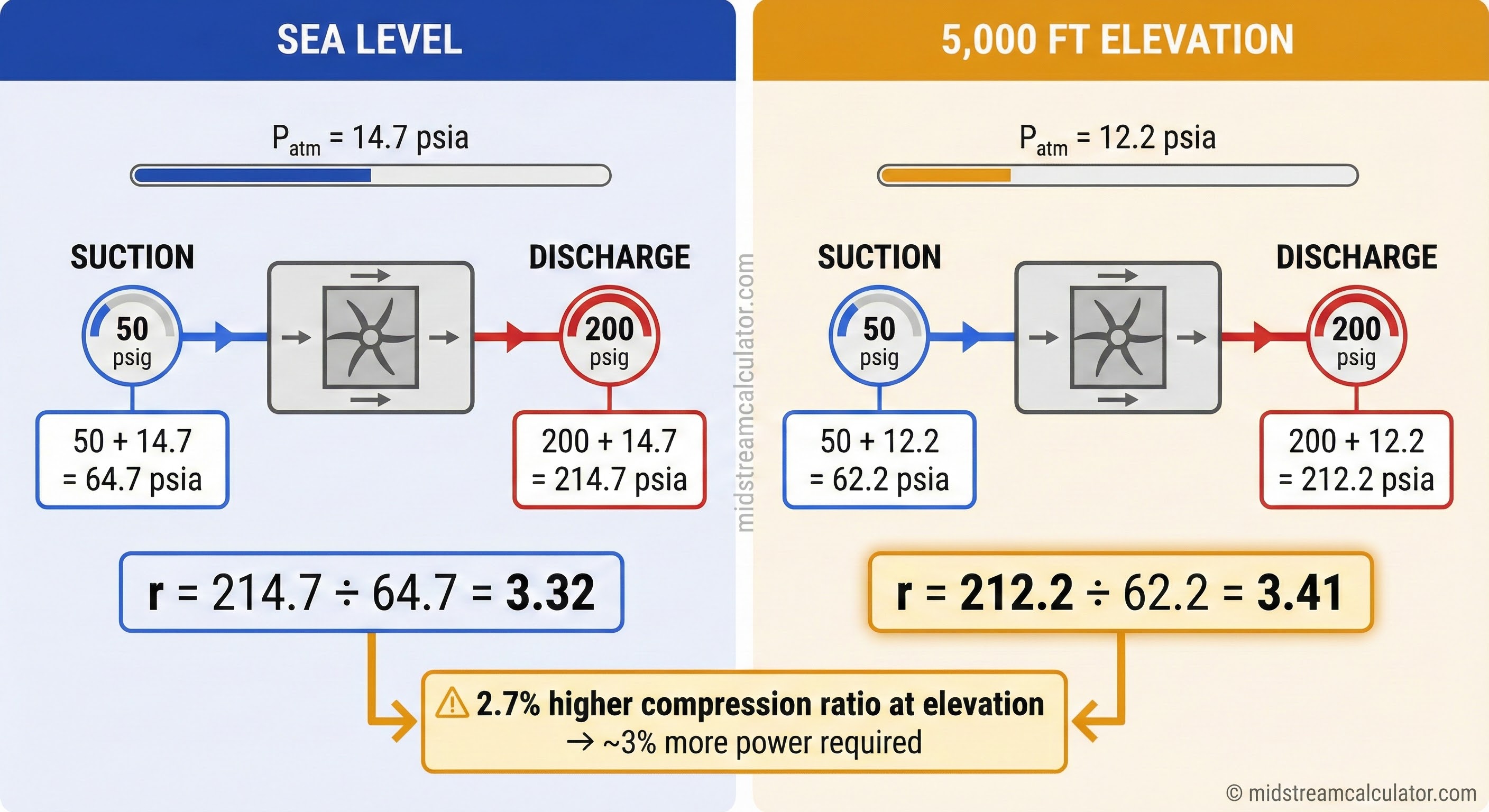
Compression ratio increases at elevation due to lower atmospheric pressure.
Gas Density
Real Gas Density:
ρ = (Pabs × MW) / (Z × R × T)
Pabs in psia, T in °R, R = 10.73 psia·ft³/(lbmol·°R)At 5,000 ft: 100 psig = 112.2 psia (not 114.7). Using sea level Patm overestimates density by 2.2%.
Compressor Ratios
Compression Ratio:
r = Pdischarge,abs / Psuction,absExample at 5,000 ft (Patm = 12.2 psia):
Suction: 50 psig → 62.2 psia
Discharge: 200 psig → 212.2 psia
r = 212.2 / 62.2 = 3.41If sea level Patm used incorrectly:
r = 214.7 / 64.7 = 3.32 (2.6% error → affects power calc)
Flow Measurement
Orifice meters (AGA 3 / API 14.3) require absolute pressure for both density (ρ) and expansion factor (Y):
ρ = Pabs × MW / (Z × R × T)
Y = 1 − (0.41 + 0.35β⁴) × ΔP / (κ × Pabs)
Using gauge pressure causes 1–3% flow error.